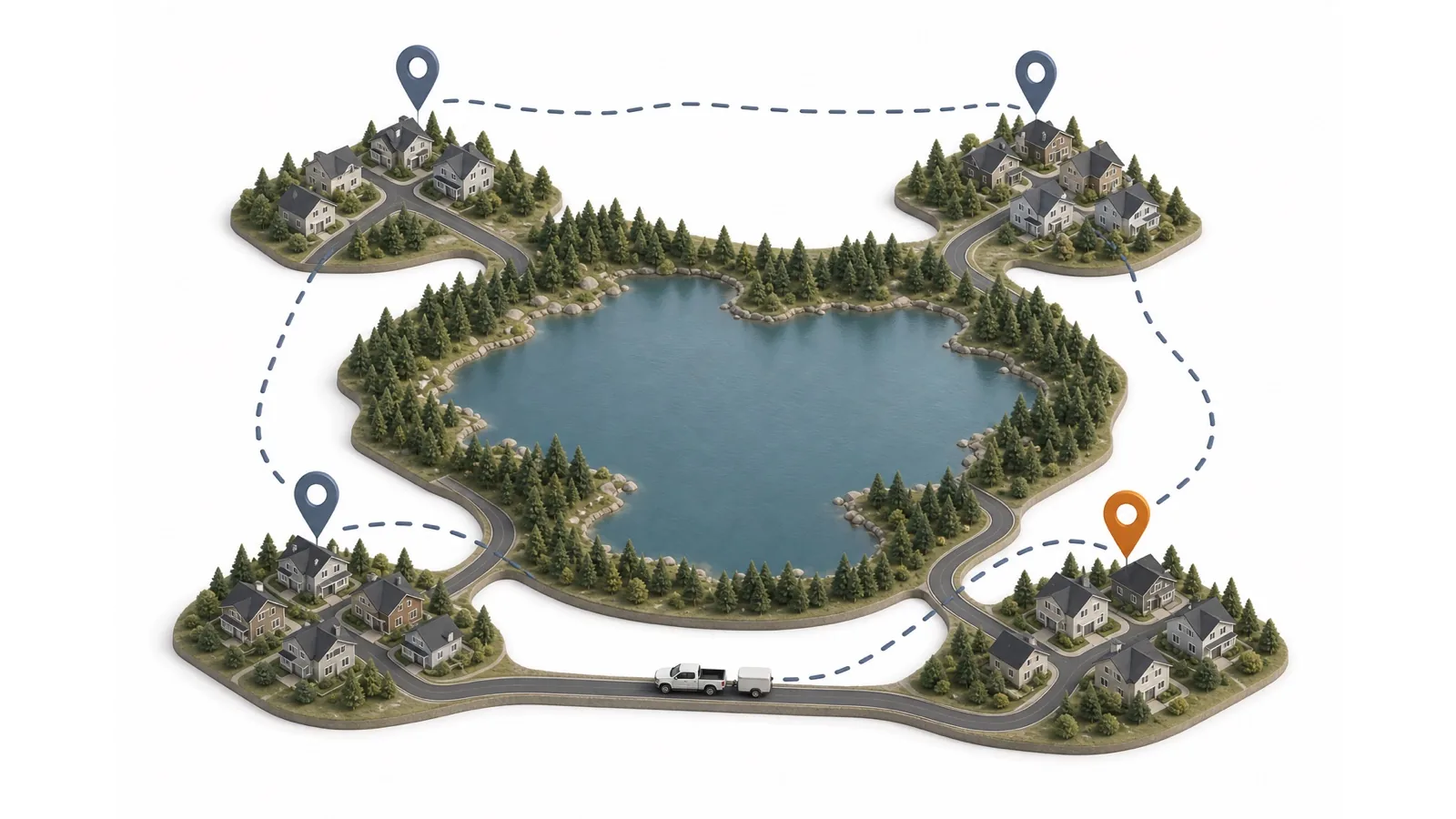
Roofing SEO is the work that puts a roofing company in front of someone who is already looking for a roof repair or a replacement in the towns that company actually serves. Four things carry the weight: a Google Business Profile that ranks in the map pack, one page per service area with a real job described on it, reviews that name the roof type and the place, and call tracking that tells you which page produced the phone call. Rankings are the scoreboard. Calls are the game.
ByteZero is a small and medium business marketing agency with offices in Van Nuys, California and Huntersville, North Carolina. Our home-services work sits in the Charlotte and Lake Norman trades: concrete, hardscapes and fencing. We do not run a roofing account today, so nothing here is dressed up as a roofing case study. What follows is the keyword data we pulled on September 21, 2026, the public storm record that sits underneath it, and the operating rules we apply to trades that sell the way roofers sell.
Key Takeaways
- Roofing search demand is not steady. In Google Keyword Planner's trailing twelve months for the United States, pulled September 21, 2026, "emergency roof repair" ranged from 3,600 to 22,200 searches a month, a swing of about six times.
- Google says local results are based mainly on relevance, distance and prominence. Distance is measured from your business location, and adding a town to a service area list does not move that pin, so a service-area page alone will not produce map pack placement across a metro.
- Town pages need something only your company can write. Google's spam policies name pages targeted at specific cities that funnel users to one page as doorway abuse.
- Paying or discounting in exchange for a positive review is prohibited under the FTC's rule on consumer reviews and testimonials, 16 CFR Part 465, published August 22, 2024. Generalized solicitations asking customers for an honest review are carved out of the prohibitions they sit under.
- "roofing seo" returns 2,400 average monthly searches in the United States at a competition index of 18. "seo for roofers" returned no metrics row at all on the same call, which is a useful reminder that a phrase you would naturally write is not always a phrase a tool can measure.
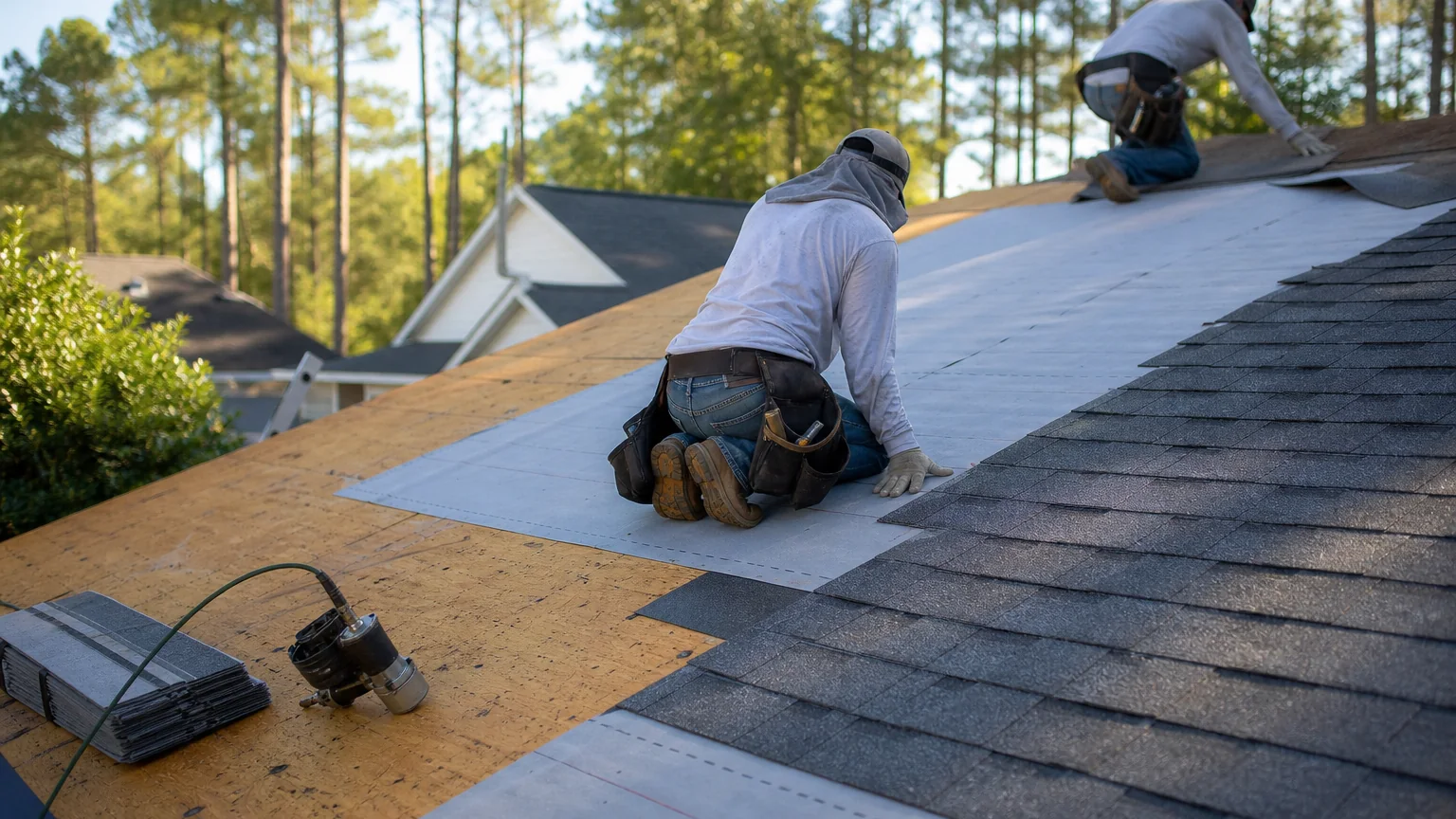
Roofing demand moves in weeks, not quarters
Every trade has a season. Roofing has weather. That distinction matters because a seasonal curve can be planned around months in advance, and a weather curve cannot.
Here is what the trailing twelve months looked like for the phrases a homeowner actually types, pulled from Google Keyword Planner for the whole United States on September 21, 2026. The swing column is the busiest month divided by the quietest one in that same window.
| Search phrase | Average monthly searches | Quietest month | Busiest month | Swing |
|---|---|---|---|---|
| roofing companies near me | 165,000 | 110,000 | 246,000 | 2.2x |
| roof repair | 74,000 | 60,500 | 110,000 | 1.8x |
| roof leak repair | 33,100 | 18,100 | 40,500 | 2.2x |
| roof replacement | 33,100 | 18,100 | 74,000 | 4.1x |
| emergency roof repair | 8,100 | 3,600 | 22,200 | 6.2x |
| hail damage roof repair | 1,000 | 480 | 1,900 | 4.0x |
Read the swing column rather than the average. The general shopping phrase, "roofing companies near me", barely more than doubles across a year. The sharpest movers, emergency repair, replacement and hail damage, swing four to six times. A roofer who staffs and spends against the average is understaffed in the weeks that pay and overstaffed in the weeks that do not.
The public storm record is a plausible driver of that volatility, though we should be careful about how far we push it. NOAA's Storm Prediction Center publishes its severe weather database as open files, and the 1955 to 2025 hail file, which we downloaded on September 21, 2026, holds 9,367 hail reports for calendar year 2025. Of those, 7,244 fell in March, April, May and June: roughly 77 percent of the year's hail reports inside four months. The 2024 file holds 9,010 reports and 2023 holds 11,760, so the annual total moves too. One honest limit on that comparison: the Keyword Planner series this tool returns carries no month labels, so we can describe how far each search phrase swings across a year but we cannot line the two curves up month by month.
The practical consequence for a roofing website is publishing order. The pages that answer distress queries, meaning emergency repair, leak diagnosis, storm and hail inspection, and the insurance claim process, should be live and indexed before the hail season, not written during it. A page published the week of the storm is competing for a spot it has no history in.
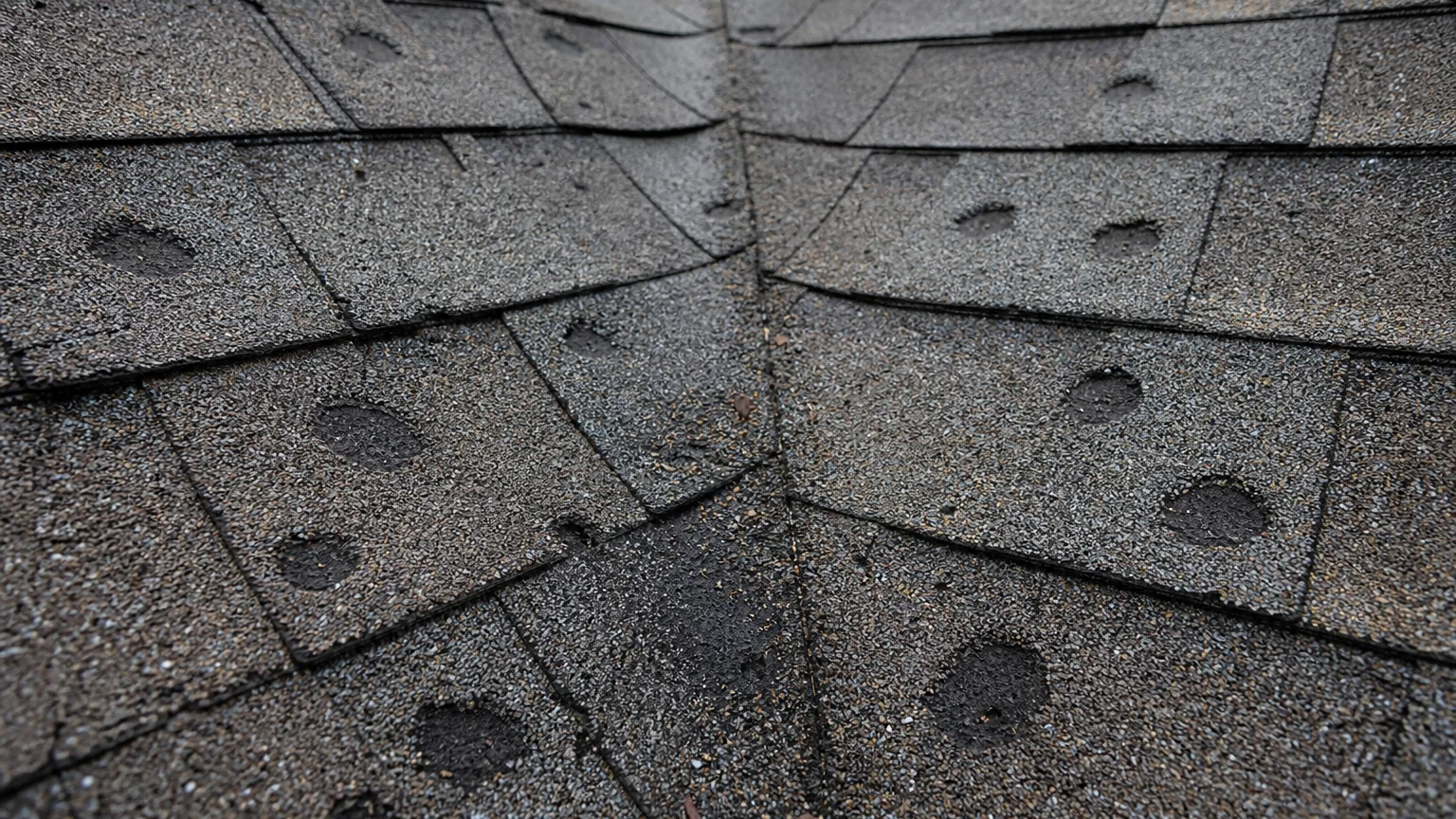
The phrase you would write is not always the phrase you can measure
We pulled eight roofing phrases in one Keyword Planner call. "roofing seo" came back at 2,400 average monthly searches, competition LOW, competition index 18. "seo for roofers", a phrase that reads more naturally and that plenty of agencies build pages around, came back with no metrics row at all. Two ways of saying the same thing; only one of them is measurable.
That is not an argument for ignoring the unmeasured phrase. It is an argument for never quoting a number next to it. When an agency shows you a proposal, every volume figure should carry three things: which tool produced it, which location it was set to, and the date of the pull. A national number is not a Charlotte number, and two tools will disagree about both. We wrote about that check in more detail in our guide to SEO for contractors.
The other number in that pull worth sitting with is "roofing companies near me": 165,000 average monthly searches at a competition index of 70. That phrase is the whole market arriving at once, and much of it resolves into a map pack. Which brings us to where the work actually is.
Where the map pack decides it, and where it does not
Google publishes how local results are ordered. Its Business Profile help page on improving your local ranking names three factors, which it heads Relevance, Distance and Prominence. Relevance is how well the profile matches the search. Distance is how far the business is from the person searching. Prominence is how well known the business is, and Google says that factor draws on how many websites link to the business and how many reviews it has.
Two of those three are only partly in your control, and that is the useful part of the model.
- Relevance is the most improvable. The primary category, the secondary categories, the services list, the description and the hours are all fields you fill in. A profile categorized only as "Contractor" competes badly against one categorized as "Roofing contractor" with roof repair, roof replacement, gutter and skylight services enumerated underneath it.
- Distance is measured from your business location. A roofer who hides the street address and runs as a service-area business still has a pin behind the profile, and that pin is what distance is calculated from. Adding a town to the service area list does not move the pin. This is a common false expectation we see in trades: the belief that a service-area page and a service-area setting together will produce map pack placement in a town an hour away. They will not.
- Prominence is the slow one. It responds to reviews and to other sites referring to the business, which means it responds to months of consistent work rather than to a week of it.
So the honest way to plan a roofing map pack strategy is by concentric rings. The towns within a short drive of the pin are winnable on profile quality and reviews. The towns at the edge of the service area are winnable on organic pages, not on the map. The towns beyond that are a paid media question or a second physical location, and no amount of page building changes that.
One page per service area, with a real job on it
The town page is where roofing sites commonly go wrong, and it goes wrong in a specific, documented way. Google's spam policies define doorway abuse as pages built to rank for similar queries that lead users somewhere less useful than the final destination.
"Having multiple domain names or pages targeted at specific regions or cities that funnel users to one page."
Google Search Essentials, spam policies, listed as an example of doorway abuse
That is a precise description of the template town page: the same eight hundred words with the town name swapped, all of them pointing at the same quote form. It is also, unfortunately, a common vendor template, because it is cheap to produce forty of them.
A town page survives that test when it contains something that could only have been written about that town. For a roofer, that list is short and entirely available to the crew:
- A job done there, described specifically: the roof type, the pitch, the problem found on tear-off, what it took to fix, how long the crew was on site.
- Photographs from that job, not stock, with the town in the filename and the alt text.
- The local permitting and inspection reality. Which authority issues the permit, whether a separate inspection is required after tear-off, what the typical turnaround is.
- Housing stock. A neighborhood of 1960s brick ranches has different roof geometry, different decking and different failure patterns than a subdivision built in 2015.
- Any HOA or architectural review requirement that governs shingle color or profile in that community.
Write four of those pages properly rather than forty of them badly. Four pages with real jobs on them will outrank forty template pages, and they will not put the domain at risk. The same principle drives how we approach contractor website design: the page set is small, and each page earns its place.
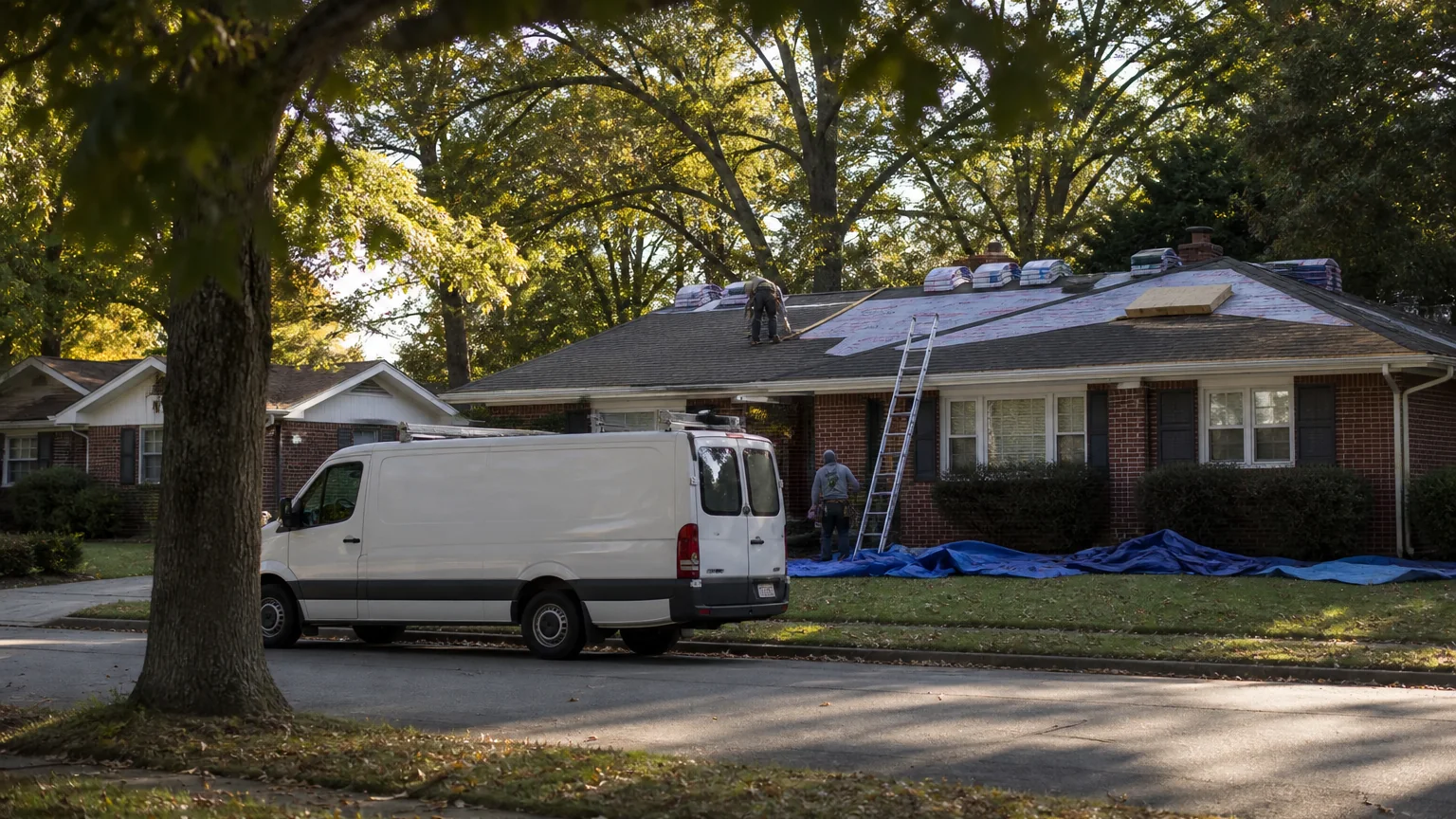
Reviews that name the roof and the town
Google's own ranking guidance says more reviews and positive ratings can help local ranking, which is why reviews are among the most contested assets in the trades. They also carry real legal exposure, and many roofers do not know the rule changed.
The Federal Trade Commission's Rule on the Use of Consumer Reviews and Testimonials, 16 CFR Part 465, was published on August 22, 2024. Three parts of it land directly on how a roofing company collects reviews.
- Section 465.4 makes it an unfair or deceptive practice to provide compensation or other incentives in exchange for, or conditioned on, reviews expressing a particular sentiment. A discount offered for a five-star review is squarely inside that.
- Section 465.5 requires an officer or manager who writes a review about their own business to clearly and conspicuously disclose that relationship, and makes it a violation for an officer or manager to push employees or their immediate relatives into writing undisclosed reviews.
- Generalized solicitations are carved out of the prohibitions they sit under. Section 465.2(d)(1) removes them from 465.2(b) and (c), and section 465.5(c)(2) removes them from 465.5(c)(1). An unconditioned ask also provides no compensation, so 465.4 is not in play. Note the scope: 465.2(d) says only that paragraphs (b) and (c) of that section do not apply, so it is not a general permission slip for the rest of the rule.
So the compliant and effective method is the same method. Ask every customer, ask the same way every time, and ask at the moment the work is visibly finished. The crew lead standing in the driveway with the homeowner looking at a finished roof is the highest-conversion moment a roofing company has, and it is free.
What makes the review useful for search, rather than just flattering, is specificity. A review that says "great job, very professional" carries no query language. A review that says the crew replaced a hail-damaged architectural shingle roof on a ranch house in Huntersville in one day and handled the insurance adjuster's visit contains the roof type, the damage cause, the town and the service. Nobody can write that for the customer, and under 465.4 nobody should pay for it. But you can absolutely ask: "if you have a minute, it helps other homeowners if you mention what we actually did and where."
Track calls by page, not by rank
A roofing lead is a phone call, often placed from a phone and often from the map pack rather than the website. That breaks the default reporting many agencies hand over, because a rank report cannot tell you which page produced a call.
What we set up for trades accounts, and what we would set up for a roofer, is this:
- A distinct tracking number on each high-intent landing page, swapped in dynamically, with the real business number as the fallback if the script does not load.
- The main business number, unchanged, on the Google Business Profile. Do not put a tracking number in the profile's primary field. The profile number is part of the business identity that other sites and directories repeat, and changing it fragments that.
- Call duration thresholds. A thirty-second call is a wrong number or a supplier. A call over two minutes is a person describing a roof. Report only the second kind as a lead.
- Form submissions and calls reported together per page per month, alongside impressions and clicks for that page.
The report that results is short and uncomfortable in a useful way. It shows which town pages produce calls and which produce nothing, which tells you where to write the next page and which existing page to rewrite. A ranking report never says that. This is the same reporting spine behind our home services marketing work and our Charlotte digital marketing accounts.
What to pay for
Roofing SEO gets sold in two shapes: a monthly retainer and a fixed project. Both can be honest. What separates them from the rest is what the month actually contains.
A retainer worth keeping is described as work, not as outcomes. It names the deliverables for the month, states who owns the accounts, and includes a report that measures calls per page. Ask what happens in month one versus month six, because the answers should differ, and ask which specific pages get written and why those pages. If the answer to "why this page" is not a search volume figure with a tool, a location and a date attached to it, the plan is decoration.
A fixed project makes sense when the site itself is the constraint: no service-area pages, a profile that has never been categorized properly, no call tracking at all. That work has an end. Ongoing content and review generation do not, and pretending otherwise is how a roofer ends up paying a retainer for a job that finished in month three.
Refuse three things regardless of shape. A guaranteed ranking position, because no one controls the ranking system. A backlink package sold by quantity, because links bought for ranking purposes are link spam under the same policy document quoted above. And any arrangement where the agency owns the Google Business Profile, the Search Console property or the analytics account. Those are yours, and an agency should be a user on them who can be removed. Our own SEO services for small business are structured on that basis for the same reason.
The first ninety days on a roofing site
In order, because the order is what makes it work:
- Weeks one and two. Google Business Profile: correct primary category, every applicable service listed, service areas set honestly, real photographs from finished jobs, hours and phone verified against the site. Fix any name, address and phone inconsistency across the major directories first, because the profile is the asset that produces calls fastest.
- Weeks three and four. Call and form tracking installed and tested with real calls from a real phone. Nothing after this point is measurable without it.
- Weeks five to eight. The service pages: repair, replacement, storm and hail inspection, gutters, and whatever else the company genuinely sells. One page each, each answering the question in its first two sentences.
- Weeks nine to twelve. The first three or four town pages, each built around a job actually done in that town, with photographs from it. Then the review process handed to the crew leads as a habit rather than a campaign.
Nothing in that list is exotic. Almost all of it is unglamorous work on assets the company already owns.
Frequently asked questions
What is roofing SEO?
Roofing SEO is the work of making a roofing company visible in local search results for the towns it serves, which in practice means the Google Business Profile and map pack, service and service-area pages on the website, reviews, and the tracking that shows which of those produced a phone call.
How long does roofing SEO take to work?
Google Business Profile changes such as categories, services and photographs can move local visibility within weeks. New pages and review-driven prominence take months, because prominence is built from accumulated reviews and references rather than from a single change. Anyone promising a ranking position by a date is describing something they do not control.
Why is my roofing company not in the map pack in nearby towns?
Google says local results are based mainly on relevance, distance and prominence, and it describes distance as how far each business is from the customer who is searching. That distance is measured from the pin behind your profile. Adding a town to your service areas or publishing a page about it does not move that pin, so towns well outside your immediate radius are usually an organic or paid question rather than a map pack one.
Are service-area pages for each town a good idea for roofers?
Yes, if each page contains something only your company could write about that town, such as a job you completed there with photographs, the local permitting and inspection process, or the housing stock and its typical roof problems. Pages that repeat the same text with the town name swapped and funnel everyone to one form match Google's own description of doorway abuse.
Can a roofing company offer a discount for a Google review?
No. The FTC's Rule on the Use of Consumer Reviews and Testimonials, 16 CFR Part 465, published August 22, 2024, makes it an unfair or deceptive practice to provide compensation or other incentives in exchange for reviews expressing a particular sentiment. Asking every customer for an honest review with no conditions attached provides no compensation, so section 465.4 is not triggered, and generalized solicitations to purchasers are separately carved out of sections 465.2(b) and (c) and section 465.5(c)(1).
Should I use a call tracking number on my Google Business Profile?
Keep your real business number as the profile's primary number, because it is part of the business identity that directories and other sites repeat. Use dynamic tracking numbers on website landing pages instead, with the real number as the fallback, so you can attribute calls to pages without fragmenting your listings.
Is roofing SEO or Google Ads better for a roofer?
They answer different problems. Paid search buys immediate presence during a storm spike, which organic cannot produce on demand. Organic and the map pack accumulate and keep producing between spikes without a per-click cost. Many roofing companies benefit from both, with paid weighted toward the distress phrases and organic toward the towns inside the map pack radius.
How many searches does roofing SEO get?
Google Keyword Planner reported 2,400 average monthly searches for "roofing seo" in the United States with a competition index of 18 on a pull dated September 21, 2026. The phrase "seo for roofers" returned no metrics row on the same call, so it has no volume figure that can honestly be quoted.