SEO for contractors is the work of making one company appear when a homeowner in one of its towns searches for the trade it does: a Google Business Profile set up as a service-area business, a page on the site for each service and each town, the license and insurance details placed where Google and homeowners look for them, reviews that keep arriving after each job, and call tracking that ties the phone ringing to the page that made it ring. Nothing in that list is exotic. What makes it contractor SEO rather than SEO in general is that the market is a list of towns, not a single address, and Google treats each town as a separate question.
We build and run this for concrete, hardscape, fencing and handyman companies in North Carolina and Florida from offices in Van Nuys, California and Huntersville, North Carolina. Below is the work as we actually do it: what goes on the profile, what goes on the site, what the state expects to see on both, and what a monthly report should show once the season is under way.
Key Takeaways
- Google ranks local results on relevance, distance and prominence, and a contractor's distance is measured from the searcher to the service area, not to an office. Set the profile up as a service-area business, hide the address if customers never visit it, and keep the area inside Google's guideline of about two hours' driving time.
- Google ranks pages, not lists. A company based in Cornelius that wants work in Huntersville and Mooresville needs a real page for each town with local detail, and a page per service or finish, because a stamped-concrete search and a driveway search are different questions.
- Build the pages where your own data shows demand. On one Lake Norman concrete build, Davidson showed 4 impressions in 12 months, so it got no page while Huntersville, Cornelius and Mooresville did.
- Put the license number on the site. California requires it in all forms of advertising under Business and Professions Code 7030.5, and North Carolina requires a state general contractor license once a project reaches the cost threshold in G.S. 87-1.
- Reviews decide the estimate before the call. In BrightLocal's February 2026 survey of 1,002 US consumers, 47% will not use a business with fewer than 20 reviews and 74% only care about reviews from the last three months, so the request has to happen after every job, not once a year.
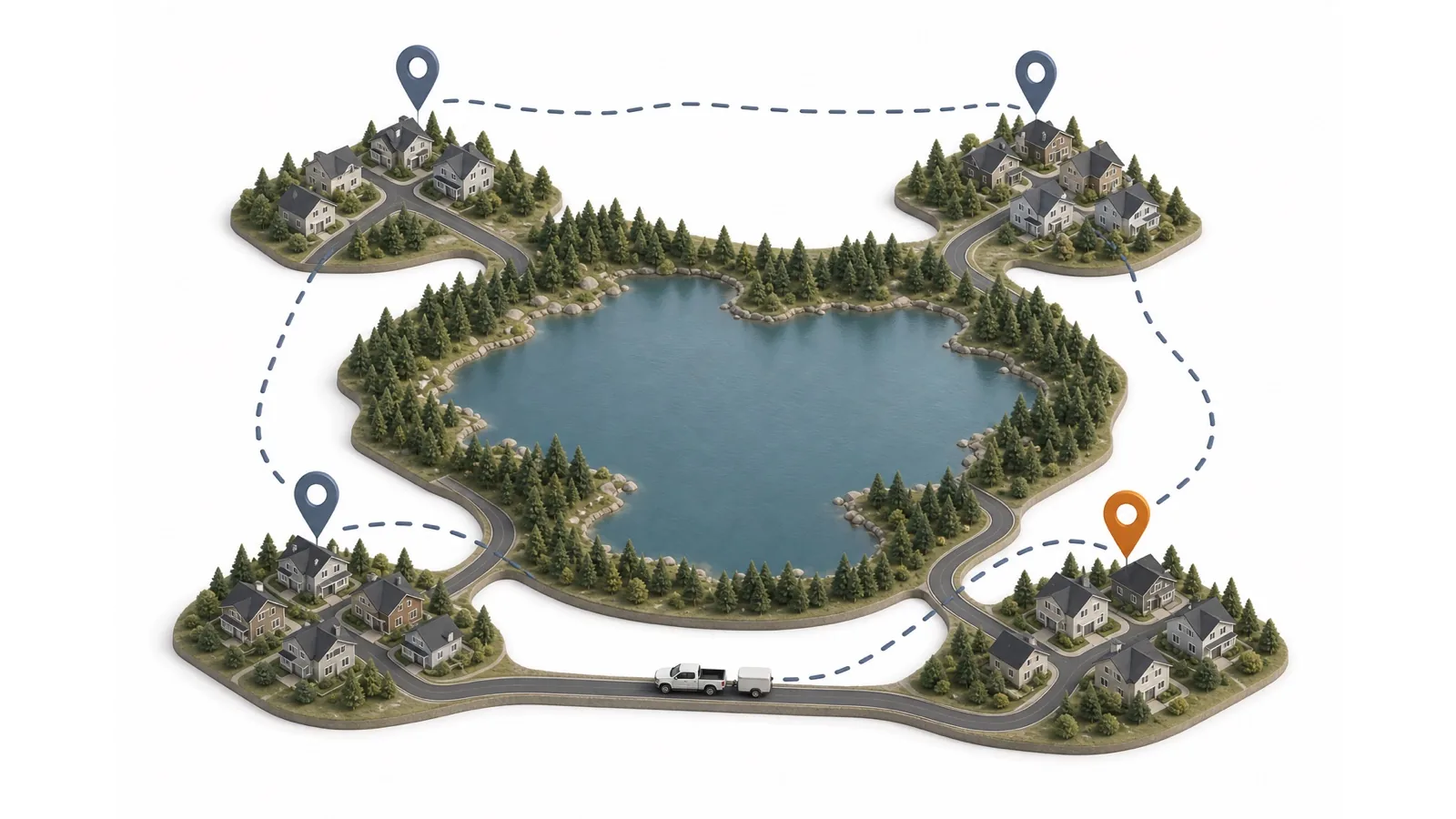
A contractor's market is a list of towns
Google's own explanation of local ranking names three factors: relevance, distance and prominence. Relevance is how well the profile matches the search. Distance is how far the business is from the person searching. Prominence is how well known the business is, which Google says is partly based on how many websites link to it and how many reviews it has. The same page adds that businesses with complete and accurate information are more likely to show up in local results.
For a shop with a counter, distance is simple. For a contractor it is not, because the crew works in Cornelius on Monday, Huntersville on Tuesday and Mooresville on Wednesday, and the office is a truck. Google handles this with the service-area business model: the profile carries the towns and counties the company serves instead of, or as well as, a street address. Google's guidelines for representing your business say that a service-area business should hide its address from customers, and that the overall service area should not extend farther than about two hours of driving time from where the business is based. A contractor who lists every county in the state does not get more work from it; the towns that actually produce jobs get diluted.
The practical consequence is that a contractor is asking to rank in four or eight markets at once, and a single homepage cannot do it. The contractors we see holding the map pack across a region have a real page for each town, with the neighborhoods, the soil and permit details a local would recognize, and finished projects photographed there. That is why the rest of this article is organized around towns and services rather than around keywords.
The profile, set up as a service-area business
Start with the primary category, because it decides which searches the profile is eligible for. A company that pours slabs and also builds paver patios has to choose whether it is a concrete contractor or a landscaper first, and the answer should follow the trade that brings in most of the revenue, with the other trades added as secondary categories. Then the services list: every service the company actually sells, named the way homeowners search for it, so the profile is relevant to a driveway search and a stamped-patio search rather than only to "concrete".
The service area itself should be the towns the crew will drive to, not the towns the owner would like to drive to. Photos are the piece contractors skip most often in the profiles we take over, and the one a homeowner comparing three companies looks at: finished jobs, captioned with the town and the work, uploaded through the season rather than in one batch at launch. The name on the profile must match the name on the license record and the name in the website footer exactly, because a homeowner who checks the license record, the profile and the site should find the same business name in all three, and a "Custom Concrete LLC" in one place and "Custom Concrete and Hardscape" in another reads as two businesses.
Everything above is a standing task, not a setup task. Google accepts suggested edits from the public, and a profile nobody reviews drifts: hours change, a category is added by someone else, a photo is attached that is not yours. A weekly look at the profile is the cheapest work in the whole program, and in our experience the most often skipped.
A page for every service and every town
The structure of a contractor site is the same across trades; the pages are not. What splits the pages is whatever splits the estimates.
| Trade | What gets its own page | Why the split matters |
|---|---|---|
| Concrete | Each finish and structure: stamped, driveways, slabs, steps, retaining walls | A stamped-patio search and a driveway search are priced and photographed differently |
| Hardscape | Paver patios, retaining walls, outdoor kitchens, fireplaces, drainage | Each structure has its own search and its own gallery |
| Fencing | Each material (wood, vinyl, aluminum, chain link), plus gates and repair | Quotes are by linear foot and material; the form should be too |
| HVAC and plumbing | Repair and replacement kept apart, emergency service on its own path | A repair click must never land on a replacement page, or the ad pays replacement prices for a repair job |
| Every trade | One page per town genuinely served | Google ranks pages, not footer lists of city names |
Town pages are where the contractor sites we audit most often go wrong, in one of two directions. The first is the footer list: eleven city names in small type at the bottom of every page, which carries almost no weight on its own. The second is the doorway page: one template, eleven copies, the town name swapped in. What ranks is a page that could only have been written about that town, which is why we write them from the owner's interviews. In Lake Norman that means the red clay a local crew already knows how to prepare, the NCDOT driveway permit a new apron needs, and which neighborhoods the crew has already worked in.
Build the pages where the data shows demand, and say no to the rest. On the Carolina Custom Concrete build, Search Console showed Davidson with 4 impressions in twelve months, so Davidson got no dedicated page while Huntersville, Cornelius and Mooresville did. That site went live on August 27, 2026 with 49 URLs in its sitemap and zero heading, redirect or orphan defects, and stands at 61 URLs today; the fastest way to get a site that clean is to generate every town page from one content source, so a fact fixed once is fixed everywhere. The full build is described on our contractor website design page.
License, insurance and the details Google and homeowners check
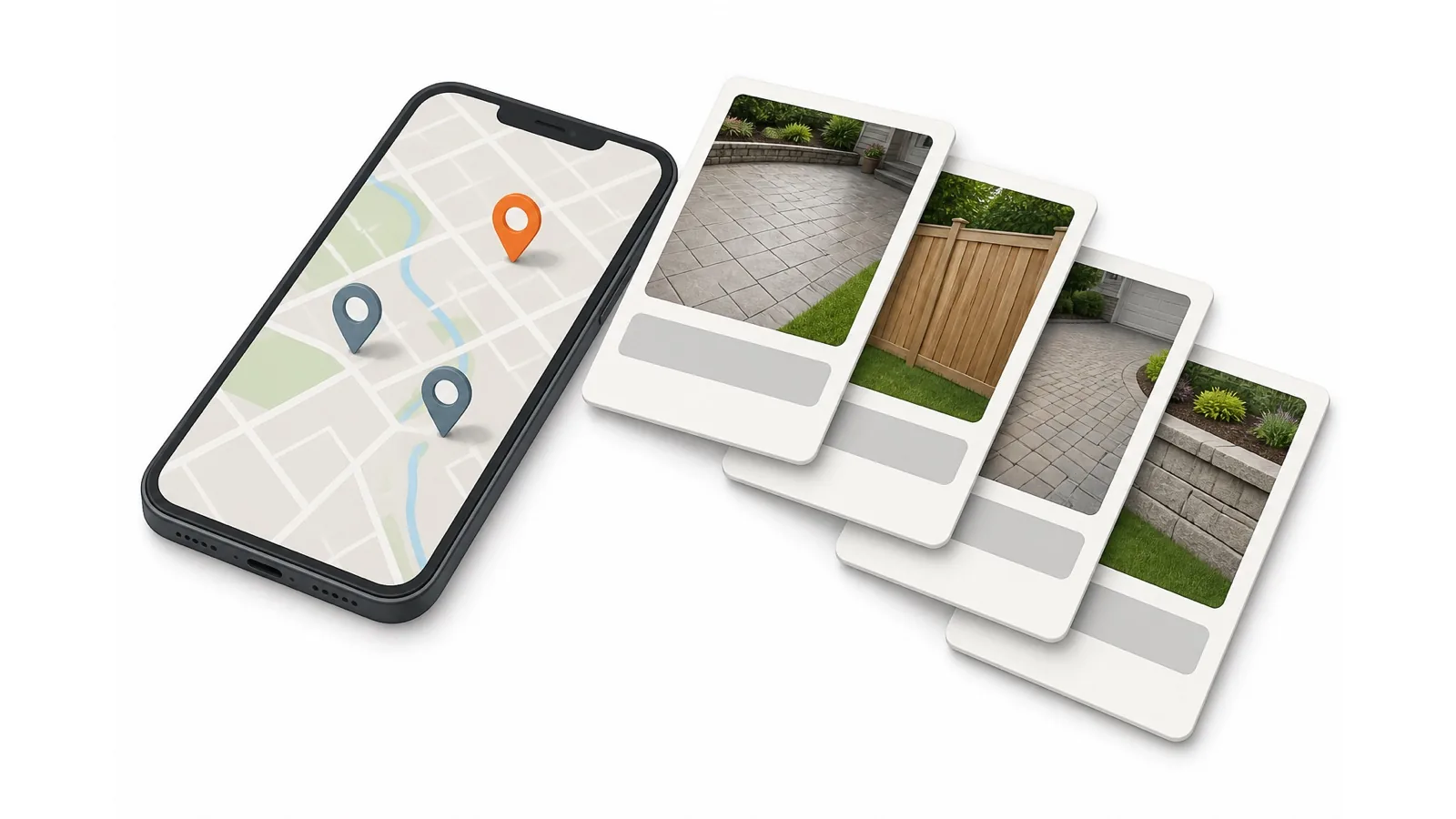
Here is the detail we put at the top of our own checklist. In California, Business and Professions Code section 7030.5 requires every licensed contractor to include the license number in all construction contracts, in subcontracts and calls for bid, and in all forms of advertising. A website is advertising. In North Carolina, G.S. 87-1 deems anyone who bids on or manages construction, grading or any improvement a general contractor once the cost of the undertaking reaches forty thousand dollars, and a general contractor must hold a state license. The rules differ by trade and state; the point for SEO is the same in both.
We put the license number, the licensing board's lookup link and the insurance statement together on the site, in the footer and again on the about page, so a homeowner can verify the company in one tap and so the details match the profile and the directories word for word. That is the "complete and accurate information" Google says it prefers, and in our own probes it is the kind of checkable, unit-bearing fact the AI assistants quote when they are asked who to hire. A site that says "licensed and insured" with no number is making a claim; a site that shows the number is making a record.
"Businesses with complete and accurate info are more likely to show up in local search results."
How to improve your local ranking on Google, Google Business Profile Help
Reviews that keep arriving after the job
Reviews are the prominence signal a contractor controls most directly, and the expectations moved this year. BrightLocal's Local Consumer Review Survey 2026, published February 11, 2026 from a panel of 1,002 US adults, found that 97% of consumers read reviews for local businesses and 41% now "always" read them, up from 29% the year before. 47% will not use a business with fewer than 20 reviews. 74% only care about reviews written in the last three months, and 32% look for reviews from the last two weeks, up from 20%. 31% will only use a business rated 4.5 stars or higher, up from 17%. Whether the owner has responded to a review is a factor for 37% of them.
Read those numbers as a contractor and the program writes itself. Twenty reviews is the floor, and the floor has to be re-earned every quarter, because a review from last spring's patio season is outside the three-month window by the time this year's homeowners are comparing. So the request is built into the job: a text with the review link when the final walk-through is done, a card left with the invoice, and a reply from the owner within the week. What an agency cannot do is write, buy or filter reviews, and one that offers to is a liability to the license, not a help to the ranking.
The off-season is when the ranking is built
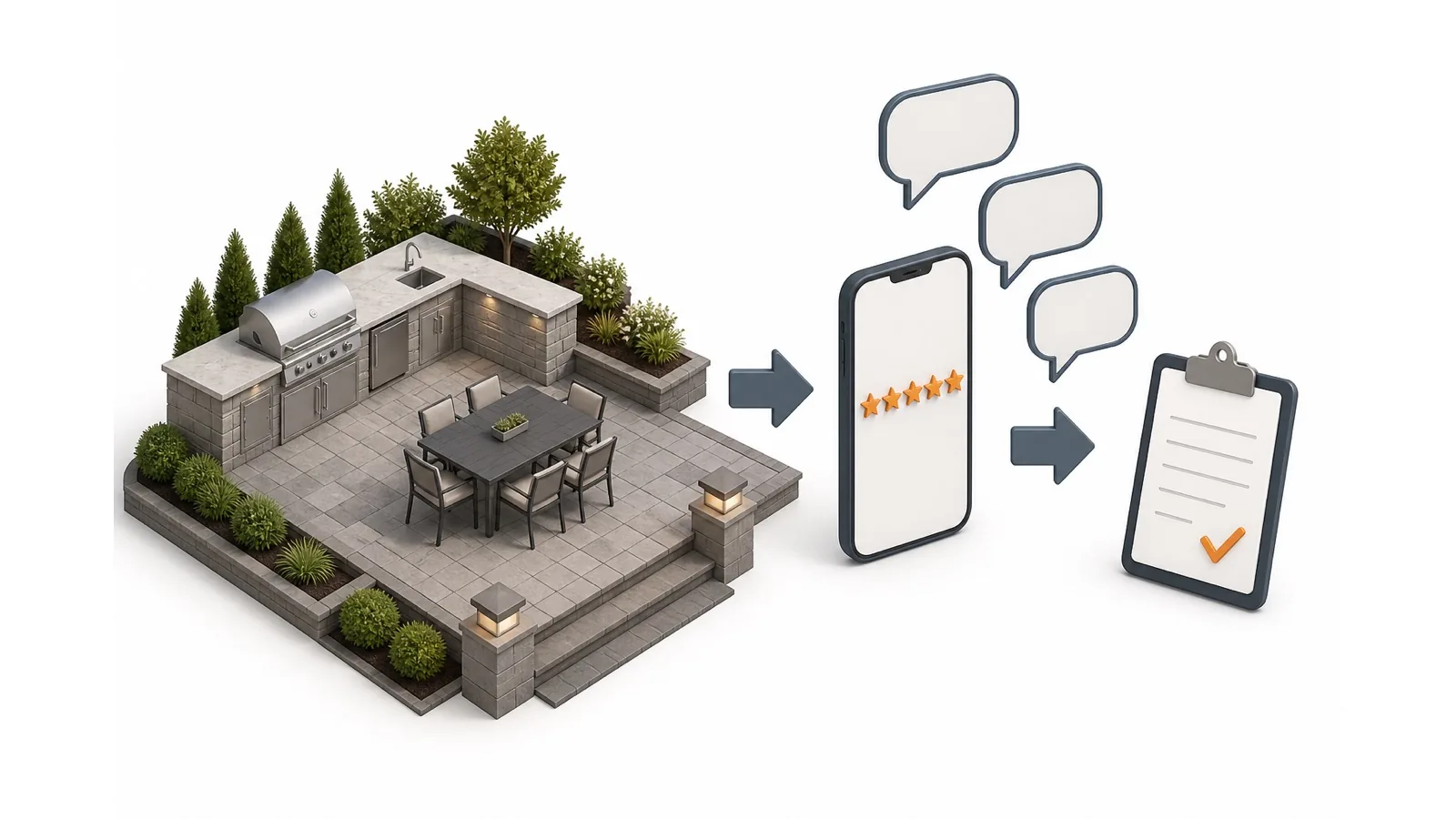
Paid search can produce calls within days of launch, which is why we usually start there for a company that needs work now. In our accounts, local SEO and map-pack movement have taken three to six months to show and kept compounding after that, so the realistic plan for many contractors is ads for this season and SEO for the season after next. Pages written and reviews collected in the quiet months are what rank when the spring rush arrives, and the town page that goes live in February is the one that answers the March search.
The same architecture protects the ad budget. When each service and each town has its own page, a stamped-concrete click from Davidson can land on a stamped-concrete page about Davidson, which in our accounts converts better and costs less than sending everyone to the homepage. The pages built for the campaign keep ranking organically after the budget is scaled down for the season.
What the AI assistants read before they recommend a contractor
Homeowners increasingly ask ChatGPT, Gemini or Google's AI Overview who to hire before they open a map. In the BrightLocal survey above, the share of consumers using ChatGPT and similar tools for local business recommendations rose from 6% to 45% in one year, making AI the third most popular source of recommendations. Those answers are assembled from structured data, reviews, directory listings and consistent business details, which means most of the work in this article is also the work of being cited, and the directories a contractor can list on, including Angi, HomeAdvisor, BBB and Houzz, matter more than they did when the only reader was Google.
It is measurable. We probe the assistants for each client's core questions and log which companies they name. On September 3, 2026, asked for a paver patio contractor in the Lake Norman area, GPT-5 with web search named Carolina Custom Stone and Hardscape first. That site had been rebuilt one-to-one after the client's platform was switched off, with 43 pages rebuilt from the original 28 and LocalBusiness and Service markup on the pages that sell. The probe is described on our SEO services page under SEO services for small business.
Measuring it: calls by page, not rankings
The monthly report for a contractor should show jobs, not positions. Rankings move for reasons that have nothing to do with customers, including the owner checking them from a phone in a town the crew does not serve. What the report should carry instead is which page produced each call, which campaign or town page produced each quote request, and how many of those became estimates and then jobs. Call tracking wired to the site's phone number, GA4 conversions wired to the forms, and a lead table the office actually keeps up are the whole measurement stack.
| Build | Trade and area | What was built | Status |
|---|---|---|---|
| Carolina Custom Concrete | Concrete, Lake Norman NC | 49 URLs in the sitemap at cutover and 61 today; town pages only where Search Console showed demand; zero heading, redirect or orphan defects in the launch sweep | DNS cut over August 27, 2026. Scope, not performance. |
| Carolina Custom Stone and Hardscape | Hardscape, Lake Norman NC | 43 pages rebuilt from the original 28, with 15 new service and material pages | Named first by GPT-5 for a Lake Norman paver patio query, September 3, 2026 |
| Outdoor Custom Hardscapes | Hardscape, Mecklenburg, Iredell, Lincoln and Cabarrus counties NC | 8 town pages, a 17-post local content program and nineteen structured-data types | Scope, not performance. See the hardscape contractor case study. |
Figures in that table describe what was built. We do not report performance results for those sites here because the honest read of a contractor's ranking work is the month-three report, and these builds are newer than that.
If you want to see the page-per-finish structure from earlier in this article on a live site, the Carolina Custom Concrete build is a fair example. Stamped concrete, concrete driveways, concrete patios and driveway replacement each have a page of their own, and the town pages for Huntersville, Cornelius, Mooresville, Denver, Concord, Troutman and Statesville sit alongside them, with no Davidson page for the reason given above. The page for their stamped concrete work is scoped to slate, brick and stone patterns for patios, driveways and pool decks, which is the finish-level question a homeowner searching for a stamped patio is actually asking and a general concrete page cannot answer.
How ByteZero runs SEO for contractors
We run the profile, the site, the reviews and the tracking as one account from Van Nuys, California and Huntersville, North Carolina. Our contractor builds so far are concrete, hardscape, fencing and handyman companies in North Carolina and Florida, and the Lake Norman work is described on our Charlotte and Lake Norman page. Our own Google Business Profile carries a 5.0 rating from 7 reviews, which is a small number, and by the standard in this article we have work to do on it too. The fastest way to see where your profile, town pages and license details stand today is a free audit and consultation.
Frequently asked questions
What does SEO for contractors include?
Five recurring workstreams: a Google Business Profile set up as a service-area business with the right primary category and every service listed, a page on the site for each service and each town genuinely served, license and insurance details placed where Google and homeowners look for them, a review request built into the end of every job, and call and form tracking that ties each lead to the page that produced it. Directory listings and structured data feed the same signals and the AI assistants read them too.
How long does contractor SEO take to bring in calls?
Paid search can produce calls within days of launch. In our accounts, local SEO and map-pack movement have taken three to six months to show and kept compounding after that, which is why the realistic plan for many contractors is ads for this season and SEO for the season after next. A new site starting from zero can move faster than an old one because there is no history to overcome.
Should a contractor show a business address on Google?
Not if customers never visit it. Google's guidelines say a service-area business should hide its address and set a service area of the towns and counties it serves, kept within about two hours of driving time from where the business is based. A contractor with a staffed showroom or supply yard that customers visit can show the address and set a service area as well.
Do I need a separate page for every town I work in?
For every town you genuinely serve and where your own data shows demand, yes. Google ranks pages, not lists, so a footer of city names carries little weight. Each town page needs local detail a doorway page cannot fake: the neighborhoods, the soil or permit issues that matter there, and finished projects photographed in that town. Where Search Console shows a handful of impressions in a year, skip the page until the demand appears.
How many Google reviews does a contractor need?
Treat 20 as the floor and recency as the real target. BrightLocal's 2026 survey found 47% of consumers will not use a business with fewer than 20 reviews and 74% only care about reviews from the last three months, so the count has to keep climbing through the season. The request should happen at the final walk-through, and the owner should reply within the week.
Does my contractor license number belong on the website?
Yes. In California, Business and Professions Code 7030.5 requires the license number in all forms of advertising, and a website is advertising. Other states set their own rules, and North Carolina requires a state general contractor license once a project reaches the cost threshold in G.S. 87-1. Beyond the legal question, a visible number next to the licensing board's lookup link is the kind of checkable detail that both Google and AI assistants treat as complete, accurate information.