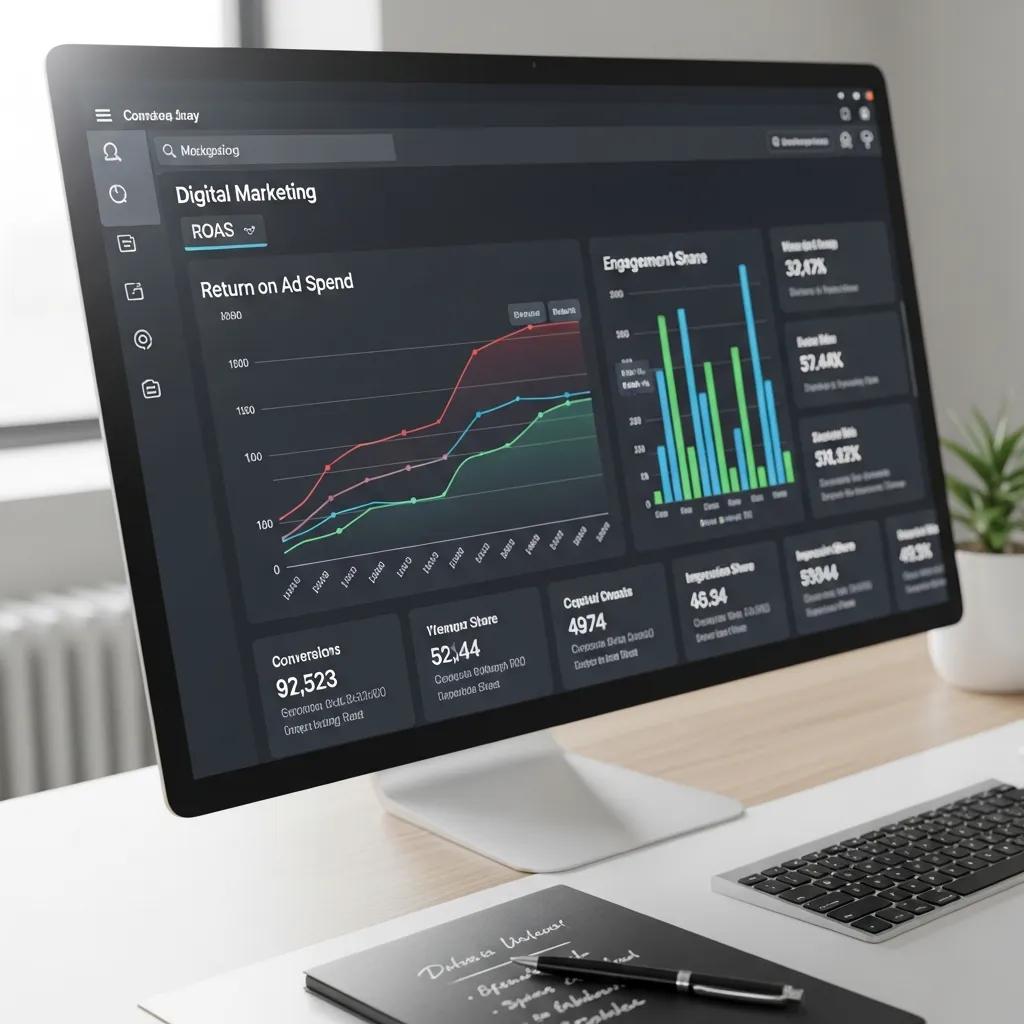
Small businesses rarely lose money on marketing because they spend too little — they lose it because they cannot see what the spend returns. Getting a clear read on digital marketing return on investment (ROI) fixes that. Once you know what each campaign costs and what it brings back, decisions about where to spend and what to cut stop being guesswork. This guide walks through the metrics worth calculating, the channels that tend to earn their keep for small teams, the measurement tools that fit a modest budget, and the habits that keep money flowing toward what actually works.
Key Takeaways
- Marketing ROI comes down to three steps: define clear goals, track every cost including tools and personnel, and measure the revenue each campaign produces.
- ROAS, qualified leads, and engagement metrics such as click-through rate are the clearest indicators of digital campaign performance.
- Social media and content marketing build brand awareness and loyalty over time, while paid ads add predictable, targeted customer acquisition.
- Google Analytics, Mailchimp, and HubSpot give small businesses enough tracking data to make budget decisions on evidence rather than instinct.
- Real-time monitoring and marketing automation let you move budget toward high-ROI channels before poor performers drain it.
What Are the Key Metrics to Calculate and Improve Marketing ROI?
You can only improve what you measure, and a handful of numbers do most of the work here. Get them right and every campaign decision gets easier, because your marketing strategies rest on evidence instead of hunches.
How to Calculate Marketing ROI for Small Businesses
The math itself is simple; the discipline is in tracking honestly. Three steps:
- Define Your Goals: Establish clear objectives for your marketing campaigns, such as increasing sales or generating leads.
- Track Costs: Accurately record all expenses related to your marketing efforts, including advertising spend, tools, and personnel costs.
- Measure Revenue: Determine the revenue generated from your marketing activities to assess the effectiveness of your campaigns.
Run this review monthly and patterns show up fast — campaigns that looked busy but earned nothing, and quiet ones that paid for themselves.
Which Metrics Best Reflect Digital Marketing Success?
A few numbers tell you most of what you need to know about digital marketing performance:
- Return on Ad Spend (ROAS): This metric measures the revenue generated for every dollar spent on advertising, providing a clear indication of campaign effectiveness.
- Qualified Leads: Tracking the number of leads that meet specific criteria helps businesses understand the quality of their marketing efforts.
- Engagement Metrics: Metrics such as click-through rates and social media interactions indicate how well content resonates with the target audience.
Read together, these numbers show where a campaign is strong and where money is leaking out.
Which Digital Marketing Channels Deliver the Highest ROI for SMBs?
Not every channel deserves a slice of a small budget. Engagement and conversion potential vary widely between them, which makes channel choice one of the highest-stakes calls a small business owner has to make.
How Do Social Media and Content Marketing Impact ROI?
Social media and content marketing earn their place in the mix in a few distinct ways:
- Brand Awareness: Engaging content on social media platforms increases visibility and helps build brand recognition.
- Engagement Metrics: High levels of interaction with content can lead to increased customer loyalty and repeat business.
- Conversion Rates: Well-crafted content can guide potential customers through the sales funnel, ultimately leading to higher conversion rates.
Used consistently, both channels compound: content keeps pulling in visitors long after it is published, and social keeps existing customers in the conversation.
What Role Does Paid Advertising Play in ROI Optimization?
Paid ads are the fastest way to buy some predictability into a marketing plan. What they add:
- Predictable Acquisition: Paid ads allow businesses to target specific demographics, ensuring that marketing efforts reach the right audience.
- Targeted Campaigns: Advertisers can tailor their messages to resonate with specific customer segments, increasing the likelihood of conversion.
- Conversion Tracking: Advanced analytics tools enable businesses to track the performance of their ads, providing insights into what works and what doesn’t.
Run with clear targets and honest tracking, paid advertising is often the quickest lever a small business has on ROI.
What Tools and Analytics Enhance Marketing ROI Measurement?
You do not need an enterprise software stack to measure ROI properly — but you do need tools that show where the money and the attention actually go.
Which Marketing Analytics Tools Are Best for SMBs?
Three tools cover most of what a small or medium-sized business needs:
- Google Analytics: This free tool offers comprehensive insights into website traffic and user behavior, helping businesses understand their audience better.
- Mailchimp: Known for its email marketing capabilities, Mailchimp also provides analytics that track campaign performance and customer engagement.
- HubSpot: This all-in-one marketing platform offers tools for tracking leads, managing campaigns, and analyzing performance metrics.
Pick one, learn it well, and let its reports — not instinct — settle your budget arguments.
How Can Real-Time Data Improve Campaign Performance?
Waiting until month-end to review a campaign means paying for weeks of underperformance first. Real-time data closes that gap:
- Optimized Bidding: Real-time insights allow businesses to adjust their bidding strategies based on current performance metrics.
- Performance Monitoring: Continuous tracking of campaign performance helps identify issues quickly, enabling timely adjustments.
- Audience Segmentation: Real-time data allows for more precise audience targeting, ensuring that marketing messages reach the most relevant consumers.
The sooner you spot a problem, the cheaper it is to fix — that is the whole case for real-time reporting in marketing campaigns.
Academic research points the same way:
Big Data & Real-Time Analytics for Digital Advertising Optimization
Digital advertising has emerged as a pivotal driver of economic growth, catalyzed by the proliferation of big data technologies and evolving consumer engagement channels. Modern advertisers capitalize on real-time analytical tools to optimize campaigns, measure effectiveness, and predict consumer behavior with unprecedented precision. This paper explores an integrative framework that harnesses big data for digital advertising, emphasizing strategies to interpret and leverage consumer behavioral insights for adaptive, data-driven decision making. By combining granular user data from diverse online and offline sources with advanced machine learning models, advertisers can identify and act upon micro-level consumer trends. In particular, this research illustrates the utility of real-time bidding infrastructures and dynamic budget allocations tailored to multichannel environments. We evaluate various data modeling techniques that incorporate both latent and explicit consumer signal
Optimizing Digital Advertising with Big Data: Analyzing Consumer Behavior for Real-Time Decision Making, 2021
How Can Small Businesses Optimize Budgets to Maximize Marketing ROI?
Where the money goes matters as much as how much there is. Deliberate allocation is what turns a modest budget into respectable ROI.
What Are Best Practices for Budget Allocation Across Channels?
A few habits keep allocation honest:
- Define Clear Goals and KPIs: Establish specific objectives and key performance indicators to guide budget decisions.
- Monitor and Optimize Regularly: Continuously track performance metrics to identify which channels are delivering the best results.
- Prioritize High-Impact Channels: Focus resources on channels that demonstrate the highest ROI potential, ensuring that marketing efforts are concentrated where they will be most effective.
How Does Marketing Automation Boost ROI Efficiency?
Automation buys back the two things small teams never have enough of: time and consistency. It helps in three ways:
- Personalization at Scale: Automation allows businesses to deliver personalized content to large audiences, increasing engagement and conversion rates.
- Predictive Analytics: Automated tools can analyze past performance to predict future outcomes, helping businesses make informed decisions.
- Dynamic Bid Optimization: Automation can adjust bids in real-time based on performance data, maximizing the effectiveness of paid advertising campaigns.
For a small team, automation is less about doing more and more about wasting less.
Research on small-business marketing automation reaches a similar conclusion:
Digital Marketing Automation for Small Business ROI
The rapid advancement of automation technology has significantly impacted digital marketing strategies, particularly for small businesses aiming to enhance efficiency and optimize operations. This study explores the implementation of automation tools in digital marketing efforts, focusing on their potential to streamline processes, improve customer engagement, and increase overall marketing effectiveness for small businesses. Automation technologies, such as customer relationship management (CRM) systems, email marketing automation, and social media management tools, allow small enterprises to reach their target audience more effectively while saving time and resources. Through an in-depth analysis of case studies and real-world applications, this research highlights how automation can assist in lead generation, customer retention, and data-driven decision-making. The findings suggest that by adopting automation, small businesses can not only boost their marketing effici
Implementation of Automation Technology in Enhancing Digital Marketing Efficiency for Small Businesses, SSD Waramena, 2025
Frequently Asked Questions
How do I measure digital marketing ROI for a small business?
Measure ROI by comparing the revenue a campaign generates against everything it cost to run. Start with a clear goal, such as sales or leads, record every expense — ad spend, software, and staff time — then track the revenue those activities produced. Reviewing this regularly shows which campaigns pay for themselves and which need adjusting, so budget decisions rest on evidence rather than guesswork.
Which metric best shows whether paid advertising is working?
Return on ad spend (ROAS) is the most direct measure, because it shows the revenue generated for every dollar spent on advertising. Pair it with conversion tracking to see which campaigns and audiences actually produce sales, and with qualified-lead counts to judge whether the traffic you are paying for matches the customers you want. Together they reveal quickly whether an ad budget is earning its keep.
Which digital marketing channels give small businesses the best ROI?
There is no single winner — the best channel is the one your own tracking proves converts. Social media and content marketing build brand awareness, engagement, and repeat business over time, while paid advertising adds predictable, targeted customer acquisition you can measure precisely. Most small businesses settle on a mix, then shift budget toward whichever channel their revenue data shows is performing.
What tools can a small business use to track marketing ROI?
Google Analytics, Mailchimp, and HubSpot cover most small-business needs. Google Analytics is free and shows website traffic and user behavior in detail. Mailchimp tracks email campaign performance and customer engagement. HubSpot is an all-in-one platform for tracking leads, managing campaigns, and analyzing performance metrics. Pick one, learn it thoroughly, and let its reports drive your budget decisions.
How should a small business split its marketing budget across channels?
Set clear goals and key performance indicators first, then let performance data decide the split. Monitor results regularly to see which channels deliver, and move money toward the ones with the strongest returns rather than spreading budget evenly. Revisit the allocation as results change — a channel that earned its share last quarter will not necessarily deserve the same share next quarter.
Does marketing automation actually improve marketing ROI?
Yes — for small teams, automation improves ROI mainly by wasting less. It delivers personalized content at a scale a small staff could not manage manually, uses predictive analytics to guide decisions, and adjusts ad bids in real time based on performance data. The result is steadier execution and fewer hours lost to repetitive work, which stretches the same budget further.