
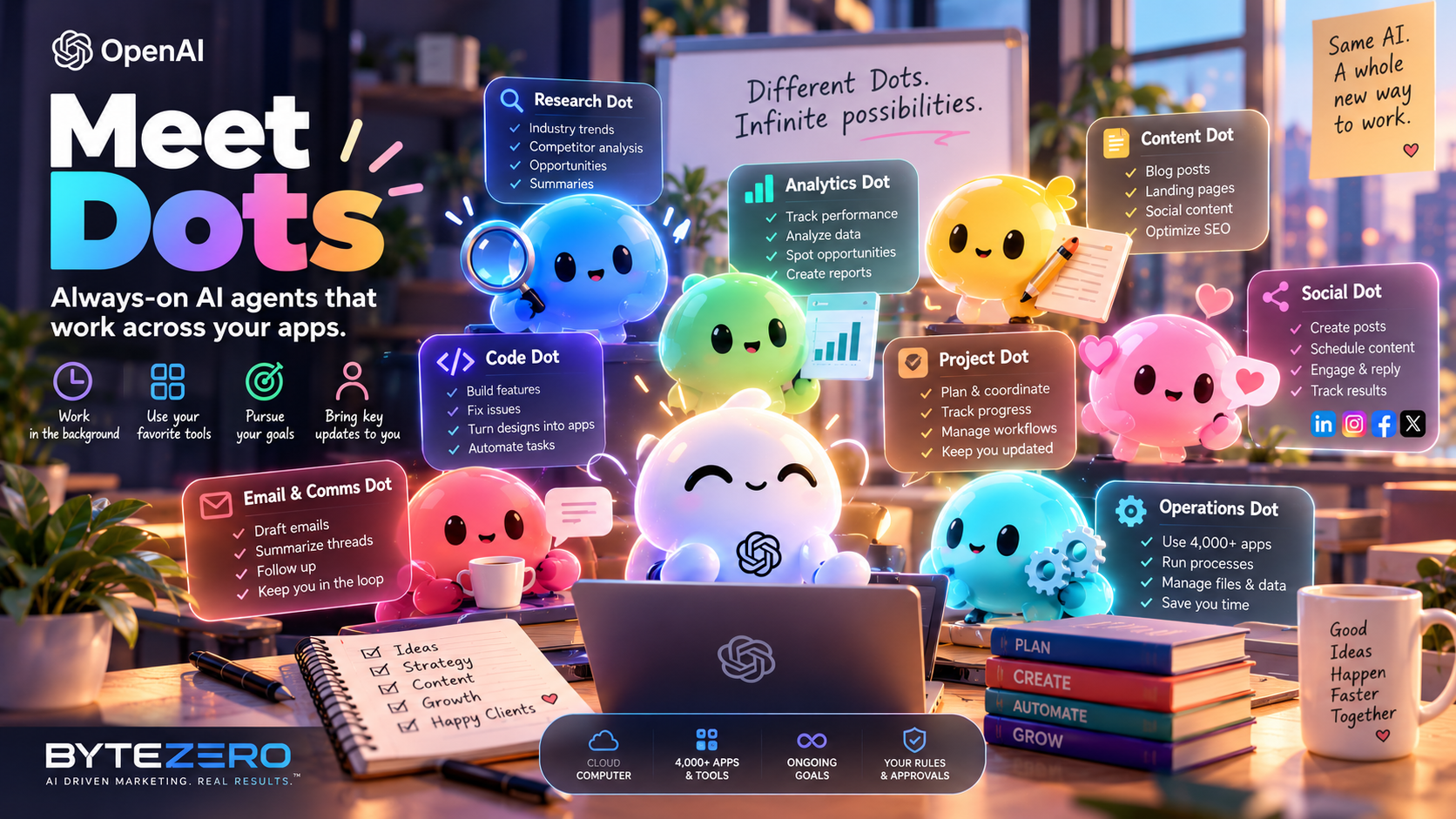
What if you could give AI a job instead of giving it prompts?
OpenAI introduced Dots on September 29, 2026: always-on AI agents designed to pursue goals across applications. Instead of treating AI as a tool you open whenever you need an answer, the idea is closer to delegating ongoing work to an agent that can keep context, use connected tools and bring important decisions back for review.
For businesses and marketing teams, the question may soon shift from “What can AI generate for me?” to “What work can I responsibly delegate to an AI agent?”
OpenAI Dots at a Glance
- A Dot is an always-on AI agent with its own cloud computer and browser.
- It can work on several evolving projects and use connected applications.
- Custom rules and approval checkpoints determine what it may do independently.
- One practical use case connects research, SEO, content, creative and social distribution.
- Reliable company data and human oversight matter more—not less—as automation increases.
What Are OpenAI Dots?
Dots are persistent AI agents designed to work toward goals on a user’s behalf. OpenAI says they are powered by GPT-6 Astra, have their own cloud computing environment and can connect through a plugin ecosystem to thousands of applications.
Traditional AI: Prompt → response → human takes the next action.
Agentic AI: Goal → research → work → verification → approval → continued monitoring.
The human still establishes the objective, permissions, source material and boundaries. The agent handles more of the repeatable work between those checkpoints.
How to Use OpenAI Dots: Seven Practical Business Use Cases
1. Build an Always-On Marketing Worker
Give the agent one controlled objective: grow and maintain our digital presence using approved company information. The workflow could connect opportunity research, SEO analysis, article production, creative development, social distribution and reporting without losing the human approval layer.
2. Maintain SEO and Business Listings
A Dot could research legitimate directories, compare existing citations with approved company information, identify missing listings and maintain a submission tracker. It could also surface broken links, weak metadata, internal-link opportunities and outdated pages for review.
The instruction should never be “build as many backlinks as possible.” Good automation scales a quality process; careless automation scales spam.
3. Run a Controlled Content Operation
With access to an approved knowledge base—services, locations, brand guidelines, target audiences, approved claims and existing content—an agent could identify useful topics, research them, prepare articles and recommend metadata and internal links.
At ByteZero, that can connect relevant content to our AI SEO services, AI search optimization guidance and the free AI visibility audit without turning every article into an advertisement.
4. Adapt One Campaign for Every Social Platform
An approved article should not become one caption pasted everywhere. A Dot could prepare a professional analysis for LinkedIn, a concise business-owner explanation for Facebook and a visual carousel or short-form script for Instagram. Public posting and sensitive replies can remain behind explicit approval.
5. Support Product, Website and Coding Work
OpenAI describes Dots investigating bugs, turning designs into working applications and revising launch materials as requirements change. A business could use the same pattern for website improvements: define the goal, provide design and factual standards, let the agent prepare the work, then review before deployment.
6. Keep Projects Moving
An agent can maintain context across a planning cycle, follow open tasks, update documents as requirements change and surface decisions that need a person. This helps when the real cost is the constant coordination around the work.
7. Update Research as Evidence Changes
A Dot could monitor approved sources, rerun an analysis when new data arrives, update figures and flag conclusions that changed. The value is not that AI knows everything. It is a repeatable process for checking new evidence against a defined question.
A Day in the Life of a ByteZero Marketing Dot
7:00 AM — Research: checks approved industry sources, competitors, search opportunities and existing content.
8:00 AM — SEO: identifies content gaps, internal-link opportunities, listing issues and pages needing attention.
9:00 AM — Content: prepares a sourced article using the company’s real services, locations and brand standards.
10:00 AM — Creative: develops featured-image and social-creative concepts.
11:00 AM — Distribution: writes distinct LinkedIn, Facebook and Instagram versions.
Ongoing — Monitoring: tracks approved projects and surfaces decisions, risks and meaningful engagement.
Human approval: public-facing or sensitive actions remain controlled.
Don’t Ask AI to Do More. Give It a System.
The difference between useful AI automation and automated chaos is context: accurate company information, defined processes, clear permissions and human approval.
Why Reliable Company Information Matters
AI automation becomes much less valuable when polished output contains an incorrect phone number, unsupported service, nonexistent location or invented claim. For an agency, approved client context may become as important as the model itself.
A practical source of truth should contain company facts, services, locations, brand rules, subject-matter resources, target audiences, approved claims, existing content and approval rules. If the agent cannot verify a fact, it should stop and ask rather than fill the gap.
From AI Tools to AI Workflows
Marketing teams already use specialized tools for writing, images, keyword research, competitors, scheduling and reporting. The work still often depends on a person manually moving information between systems.
Agentic AI attempts to connect the workflow around those tools. The agent becomes an orchestration layer that understands the objective, selects the right tool, checks the result and brings consequential actions back for approval.
AI Agents Could Change Search Itself
Businesses are not the only ones getting AI agents. Customers are too. AI assistants increasingly research services, compare options and help people make decisions before they visit a company website.
Businesses may eventually communicate with two audiences: people and the AI systems helping those people make decisions. Traditional SEO remains important, while clear, structured and trustworthy information becomes more valuable when machines are interpreting a company as well.
Where Humans Still Matter
An agent can execute the wrong objective extremely efficiently. People still need to determine what the business is trying to accomplish, who the customer is, what differentiates the company, which claims are appropriate, what quality looks like, which actions require approval and when automation should stop.
Should Your Business Start Using AI Agents?
Do not automate everything simply because you can. Start with a repetitive process that has:
- a clearly defined objective,
- reliable source data,
- repeatable rules,
- measurable outcomes, and
- appropriate approval checkpoints.
Begin with research, monitoring or draft preparation before allowing an agent to publish or contact anyone. The objective should not be maximum automation. It should be useful automation with accountability.
The Bigger Picture
OpenAI Dots arrive as the technology industry moves from conversational AI toward agents capable of pursuing longer-running goals and taking actions using connected tools. For marketers, that could connect research, SEO, content creation, social media, reporting and optimization into continuous workflows.
The companies that benefit most probably will not be the ones that generate the largest volume of AI content. They will be the ones with clean data, strong processes, useful content, clear brand rules and thoughtful oversight.
AI agents can make execution faster. They still need businesses to tell them what good looks like.
Want to see whether AI assistants can accurately understand and recommend your business? Start with ByteZero’s free AI visibility audit.