HVAC SEO is the work that puts a heating and cooling company in front of a homeowner who is searching for a repair or an installation in the towns that company serves. The phrase "hvac seo" averages 720 searches a month in the United States, according to Google Keyword Planner on September 28, 2026. ByteZero is a small and medium business marketing agency with offices in Van Nuys, California and Huntersville, North Carolina, and this is how we would build search for an HVAC company.
We do not run an HVAC account today, so nothing below is presented as an HVAC case study. Our home-services work sits in the Charlotte and Lake Norman trades: concrete, hardscapes and fencing. What follows is keyword data we pulled ourselves, Google's and the EPA's own published rules, and the operating method we apply to trades that sell by phone call. The HVAC twist is that the phone rings for two different reasons in two different halves of the year.
Key Takeaways
- In Google Keyword Planner's trailing twelve months for the United States, pulled September 28, 2026, "furnace repair" peaked in month five of the series and "ac repair" peaked in month eleven. Heating and cooling demand run on separate curves, six months apart in that window.
- Symptom phrases swing hardest. "furnace not working" ran from 170 to 3,600 searches a month, about 21 times, while "hvac near me" barely moved at 1.2 times.
- Google treats HVAC as an urgent Local Services Ads category, with business, owner and service professional background checks, and says screening takes 3 to 4 weeks on average after documents are submitted.
- EPA Section 608 certification is required for technicians who service equipment that could release refrigerant, and EPA says the credential does not expire. Naming the certification type on a service page is a trust signal a homeowner can check.
- Google's spam policies name city-targeted pages that funnel users to one page as doorway abuse, so an HVAC service-area page needs something only that company could write about that town.

Two demand curves, six months apart
A roofer's demand follows the weather. An HVAC company's demand follows the thermostat, and the thermostat has two seasons. That difference changes the whole publishing calendar.
We pulled ten homeowner phrases from Google Keyword Planner for the whole United States on September 28, 2026. The swing column is the busiest month divided by the quietest month in the same trailing twelve months. The peak column is where the busiest month sits in the series, counted from the oldest month.
| Search phrase | Average monthly searches | Quietest month | Busiest month | Swing | Peak (month of 12) |
|---|---|---|---|---|---|
| ac repair | 368,000 | 165,000 | 673,000 | 4.1x | 11 |
| ac repair near me | 201,000 | 110,000 | 301,000 | 2.7x | 1 and 2 |
| furnace repair | 201,000 | 60,500 | 450,000 | 7.4x | 5 |
| hvac near me | 165,000 | 165,000 | 201,000 | 1.2x | several |
| furnace repair near me | 74,000 | 27,100 | 135,000 | 5.0x | 5 |
| hvac repair | 74,000 | 49,500 | 110,000 | 2.2x | 11 |
| heat pump repair | 40,500 | 14,800 | 110,000 | 7.4x | 5 |
| emergency ac repair | 14,800 | 5,400 | 60,500 | 11.2x | 11 |
| ac not cooling | 6,600 | 880 | 14,800 | 16.8x | 11 |
| furnace not working | 1,300 | 170 | 3,600 | 21.2x | 5 |
Three things in that table matter more than the averages.
First, the heating phrases (furnace repair, furnace repair near me, heat pump repair, furnace not working) all peak in month five of the series. The cooling repair phrases (ac repair, hvac repair, emergency ac repair, ac not cooling) all peak in month eleven. One honest limit: the Keyword Planner series this tool returns runs oldest to newest with no month names, so we can say the two peaks sit six months apart but we cannot state which calendar months they are. Anyone who has worked a heating season can guess. We would rather not print the guess as data.
Second, the generic phrase is flat. "hvac near me" moved between 165,000 and 201,000 across the year, a swing of 1.2 times, at a competition index of 75, the highest in the pull. The symptom phrases, the ones a homeowner types while standing next to a dead unit, swing 17 to 21 times. "furnace not working" dropped to 170 searches in its quietest months and climbed to 3,600 at its peak.
Third, the phrases that swing hardest carry low or medium competition. "furnace repair" sits at a competition index of 4 and "heat pump repair" at 2. That is where organic pages have room.
The practical consequence is a split calendar. Heating pages get written, published and indexed while cooling season is running, and cooling pages get the same treatment during heating season. A furnace page published the week the first cold snap hits is trying to rank with no history, against pages that were indexed months earlier.

Emergency and repair pages that answer the 2 a.m. search
Somebody typing "ac not cooling" is not comparing agencies or reading reviews at leisure. They want to know whether it is something they can check themselves and, if not, who can come out. A repair page that makes them scroll past a company history to find a phone number has lost them.
For each repair service, the page we would build answers in this order:
- The phone number and whether you answer after hours, in the first screen, stated exactly as true. If nights are voicemail and a callback in the morning, say that. In our view a false "24/7" does more damage in reviews than it earns in calls.
- The two or three checks a homeowner can safely do first: the thermostat mode, the breaker, the filter. Some callers will fix it themselves. The page still did its job: it answered the search, and the company name is now the one they saw.
- What the technician does on arrival, in plain order, for this specific failure.
- The equipment you actually service: furnace, heat pump, central air, ductless, by fuel type where it matters.
- The towns you reach, named, not "and surrounding areas".
Write one page per failure people search for, not one "HVAC services" page with twelve bullets. "furnace repair" and "heat pump repair" have different peaks in the table above, different competition and different fixes. They deserve different pages.
Service-area pages that are not doorways
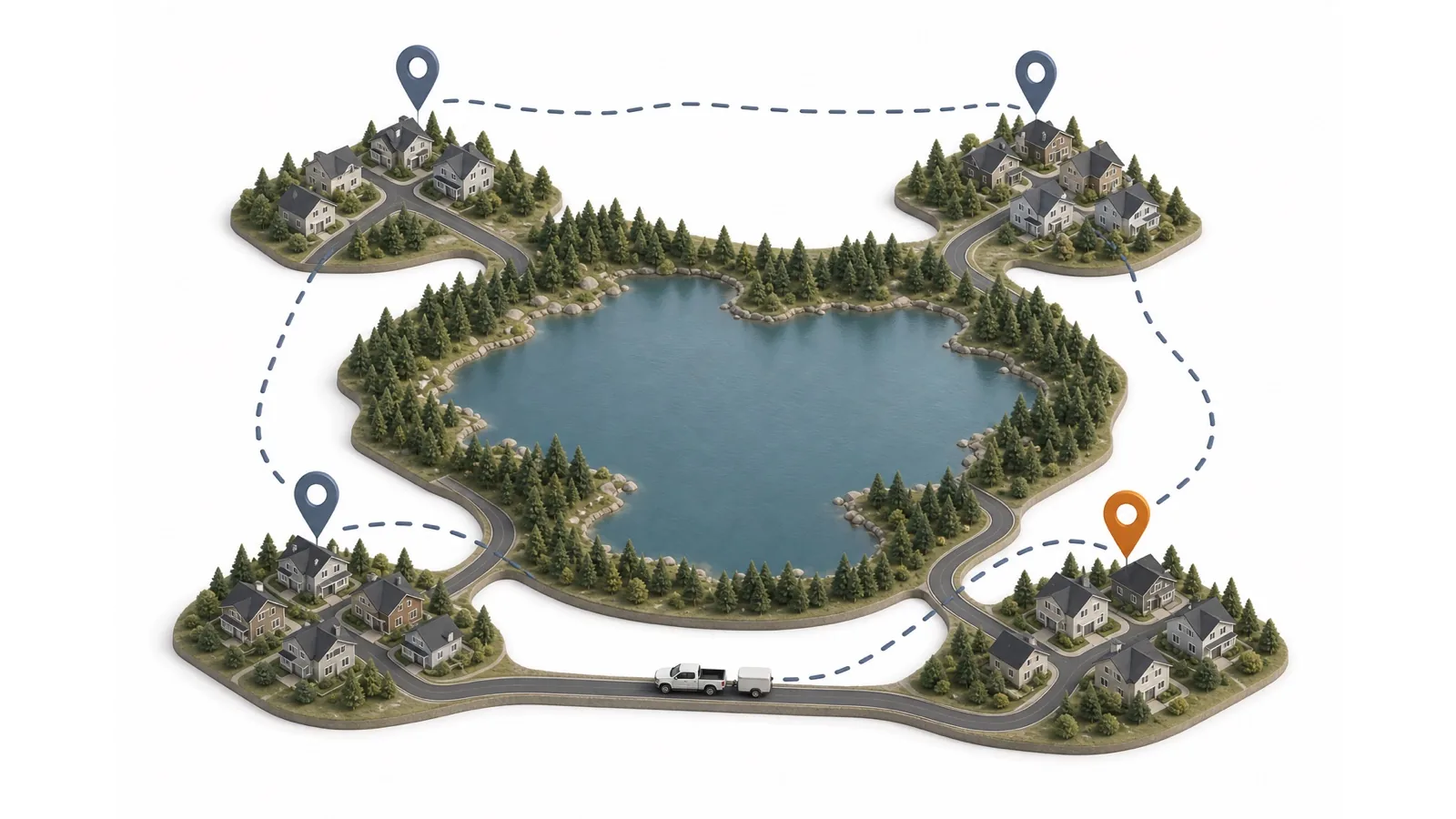
Google's Business Profile guidelines set two rules that shape how an HVAC company defines where it works. A service-area business should hide its business address from customers, and the overall service area should not extend farther than about 2 hours of driving time from where the business is based. The same guidelines say a virtual office is not eligible for a Business Profile, and an office at a co-working space qualifies only if it has clear signage, receives customers and is staffed by your own people during business hours.
The website side has its own limit. Google's spam policies list, as an example of doorway abuse, "having multiple domain names or pages targeted at specific regions or cities that funnel users to one page." That describes the template town page closely: the same text with the town name swapped, forty times, each copy pointing at the same form.
An HVAC town page earns its place when it holds something that could only be written about that town:
- A real job there: the system type, what failed, what was replaced or repaired, and how long the crew was on site.
- The housing stock. A neighborhood of older homes with original ductwork has different problems from a newer subdivision built around heat pumps.
- Which authority issues mechanical permits for a replacement in that town, if one is required, and how the inspection is scheduled.
- Photographs from that job, not stock.
Four of those pages written properly beat forty written from a template, and they do not put the domain at risk. We laid out the same test for roofers in our guide to roofing SEO, and the reasoning carries over: the page set stays small and each page carries evidence.
Map pack, Local Services Ads and organic: which one books the call
An HVAC search results page can show three different things above the fold: Local Services Ads, the map pack, and organic results. Each is earned differently, and a plan that treats them as one channel wastes effort.
Local Services Ads are a paid unit with its own gate. Google's business screening and verification requirements for the United States put HVAC in a small group of urgent categories, alongside electricians and garage door companies:
"The HVAC category is considered an urgent category because consumers often call HVAC professionals for time-sensitive, urgent needs, such as a heater that is broken in freezing temperatures."
Google Local Services Help, business screening and verification requirements (United States)
Because of that status, Google says HVAC professionals undergo an additional level of screening that includes service professional background checks. The HVAC listing on that page names a business check, an owner check and a service professional check, general and professional liability insurance, and state-level business and owner licenses where local law requires them. Local Services advertisers also need a public, verified Google Business Profile, and Google puts the screening at 3 to 4 weeks on average after documents are submitted. Put those two facts next to the demand table and the operational point is plain: start screening well before the season you want to advertise in, because a background check that clears after the peak month buys you nothing that year.
The map pack is driven by the Google Business Profile. The guidelines say to choose the fewest categories it takes to describe the core business, and to pick categories that complete the statement "this business IS a" rather than "this business HAS a". They also bar service or product information in the business name, so a name padded with "AC Repair and Heating" is a guideline problem, not a ranking trick.
Organic is where the repair and town pages live, and it is the channel that keeps producing between peaks without a per-click cost. Paid search, including Local Services Ads, buys presence during the spike, when organic cannot be switched on. We run paid and organic as one plan for trades clients where paid is in scope, through our paid ads management work, weighting paid toward the symptom phrases in peak weeks.
Put the Section 608 certification on the page
An HVAC company has a trust signal that a roofer or a painter does not: a federal technician certification. The EPA's Section 608 technician certification requirements say that technicians who maintain, service, repair or dispose of equipment that could release refrigerants into the atmosphere must be certified, by passing an EPA-approved test given by an EPA-approved certifying organization. EPA lists four types: Type I for small appliances, Type II for high- or very high-pressure appliances other than small appliances and motor vehicle air conditioners, Type III for low-pressure appliances, and Universal for all types. EPA also states that Section 608 credentials do not expire.
It is also easy to leave off a website, because it lives on a card in a technician's wallet. What we would publish:
- On each technician's short bio: the certification type they hold and the certifying organization that issued it. EPA does not issue the cards itself, so name the organization rather than implying the card came from the agency.
- On the repair pages that involve refrigerant, one plain sentence: the technicians who handle refrigerant on your system are Section 608 certified.
- No card numbers or photos of cards. The type and the issuer are enough for a homeowner to understand what they are looking at.
This is the kind of detail that separates a page written by someone in the trade from one assembled by a content vendor. It sits alongside the license and insurance facts that Local Services Ads screening checks, so the page and the ad describe the same company in the same terms.
What an HVAC company should measure instead of rankings
A rank report cannot tell you which page produced a no-heat call in the first cold week. For trades accounts, and for an HVAC company, we would set up the following:
- A distinct tracking number on each high-intent page, swapped in dynamically, with the real business number as the fallback. The real number stays on the Business Profile, because it is part of the identity directories repeat.
- Calls split into heating and cooling by the page they came from. The two curves peak at different times, so a single blended call count hides which half of the site is working.
- Local Services Ads leads reported as their own line. They come from the ad unit, not from a page on your site.
- A duration threshold on calls, so a wrong number or a supplier is not counted as a lead.
- For each page, per month: impressions, clicks, calls and forms, side by side.
After one full year, that report tells you something no ranking report does: which season's pages are underbuilt. The site design side of that, meaning where the number sits and how the repair page reads on a phone, is covered in our notes on contractor website design, and the wider trades reporting method sits behind our home services marketing work.
The number behind "hvac seo" itself
The agency-side phrase has its own curve, and it is worth being straight about it. On the September 28, 2026 pull, "hvac seo" averaged 720 searches a month at a competition index of 20. "hvac seo services" also came back at 720 with an index of 8, and "seo for hvac companies" at 390 with an index of 12. But the twelve-month series for "hvac seo" ran from 1,900 in the oldest month down to 210 in the newest, with the last five months at 320 or below. The 720 average describes a year, not this month.
That is a small example of a check worth applying to any agency proposal, ours included: every volume figure should come with the tool, the location, the date, and ideally the monthly series. An average hides a trend. We made the same argument in our guide to SEO for contractors, and the HVAC numbers make it again.
Who this approach is not for: a company that wants to cover a metro several hours wide from one location, or one that needs calls next week and has no pages at all. The first runs into Google's guideline that a service area should, in most cases, not extend beyond about 2 hours of driving time. The second is a paid search question first and an SEO question after.
Questions about HVAC SEO
What is HVAC SEO?
HVAC SEO is the work of making a heating and cooling company visible in search for the repairs, installations and towns it serves, which covers the Google Business Profile and map pack, repair and service-area pages, trust signals such as EPA Section 608 certification, and call tracking that shows which page produced a call.
How many searches does HVAC SEO get?
Google Keyword Planner reported 720 average monthly searches for "hvac seo" in the United States, competition index 20, on September 28, 2026. Its twelve-month series fell from 1,900 in the oldest month to 210 in the newest, so the average describes the year rather than the current month.
When should an HVAC company publish heating and cooling pages?
Publish each season's pages during the opposite season. In Keyword Planner's trailing twelve months, heating repair phrases peaked six months apart from cooling repair phrases, so a page written during the peak has no indexing history when the demand arrives.
Are service-area pages for each town a good idea for HVAC companies?
Yes, when each page contains something only your company could write about that town, such as a job completed there, the local housing stock and its typical system problems, or how mechanical permits and inspections work locally. Pages that repeat the same text with the town swapped and funnel to one form match Google's description of doorway abuse.
How long does Local Services Ads screening take for HVAC?
Google says the screening and verification process takes 3 to 4 weeks on average after documents are submitted. HVAC is treated as an urgent category, with business, owner and service professional background checks, so the process should start well before the season you want to advertise in.
Should HVAC websites mention EPA Section 608 certification?
Yes. The EPA requires Section 608 certification for technicians who service equipment that could release refrigerants, and states the credential does not expire. Naming each technician's certification type and the certifying organization on the site is a trust signal a homeowner can check.
Can I put "AC repair" in my Google Business Profile name?
Not unless it is part of your real business name. Google's Business Profile guidelines prohibit adding service or product information to the business name, so descriptive keywords belong in categories, services and the description instead.