
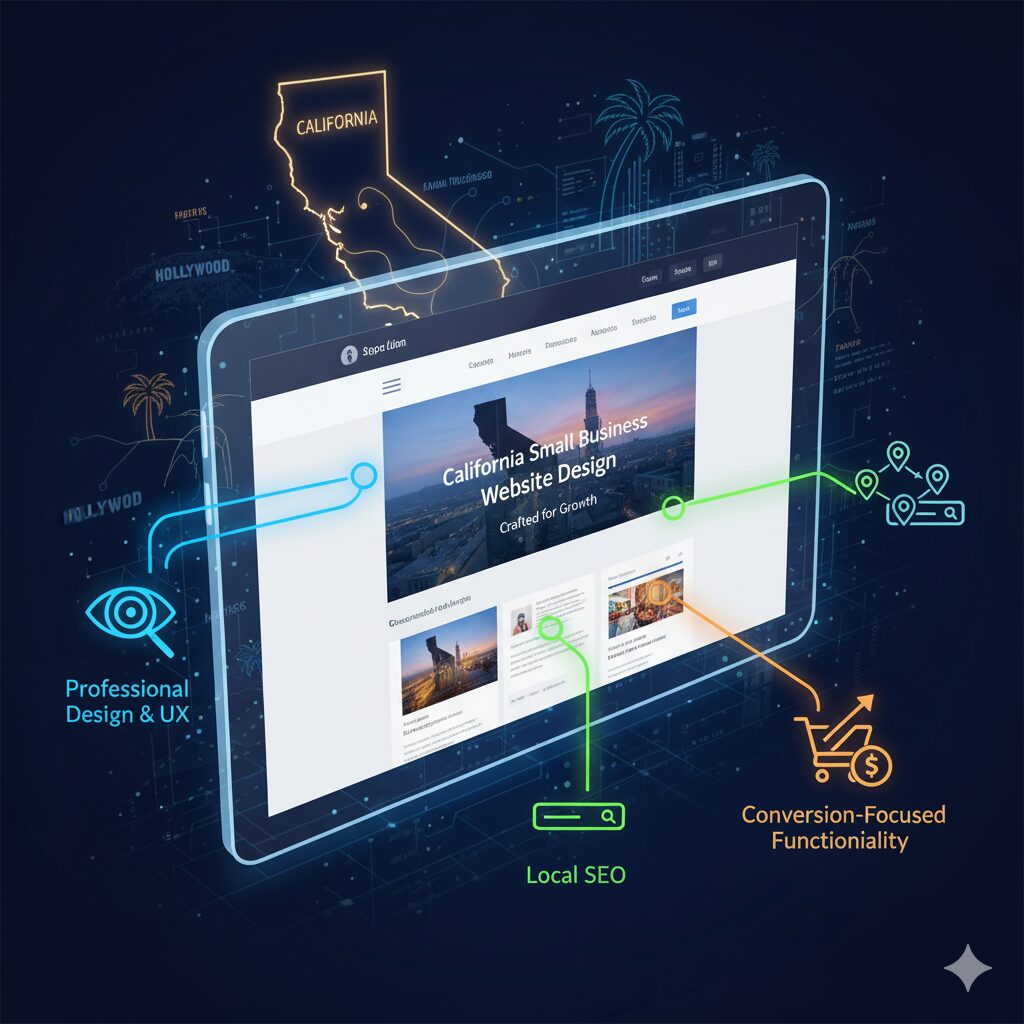
Your Digital Foundation in the Golden State
California is a crowded market, and a website is no longer an optional add-on. It is the digital foundation of the business. Whether you run a boutique in Los Angeles, a cafe in San Francisco, or a service business in San Diego, your site is usually the first point of contact a potential customer has with you. It is your storefront, your brand story and your always-open sales desk.
Key Takeaways
- In California your website is usually the first contact a customer has with you, so it has to work as storefront, brand story and sales desk at once.
- Intuitive navigation, mobile responsiveness and fast loading are what separate a professional site from one that quietly loses visitors.
- A majority of web traffic comes from mobile devices, so a layout that breaks on a phone is a flaw rather than an inconvenience.
- Local SEO means content that names Los Angeles and the neighborhoods you serve, built around the terms your audience actually searches for.
- Clear calls to action, easy contact options, an SSL certificate and accessible design are what turn a visitor into a customer.
So what makes a website effective? Design is only part of it. The site has to solve a problem for the person visiting and give your business somewhere to send them. Here are the elements that matter most for a small business in California.
The Three Pillars of an Effective Small Business Website
1. Professional Design and User Experience (UX)
The look of a site sets expectations before anyone reads a word, and a professional one earns credibility that a dated one does not. That goes well beyond aesthetics. A good experience means:
- Intuitive navigation: customers should find what they are looking for within seconds. Confusing menus and buried information lead to frustration and high bounce rates.
- Mobile responsiveness: a majority of web traffic comes from mobile devices. A site that is not optimized for smartphones and tablets is not just an inconvenience, it is a critical flaw that drives customers away.
- Fast loading speeds: few visitors will wait around. Every second your site takes to load can cost you customers, which is why optimized images and clean code matter.
2. Search Engine Optimization (SEO)
Even a well-built website is useless if nobody can find it. SEO is the work of making your pages visible on search engines such as Google. For a California business that means a localized strategy, so the right people find you at the moment they are looking.
- Localized content: a website that mentions Los Angeles and the surrounding neighborhoods helps you rank for local searches, so you appear when someone searches for a coffee shop near me or a plumber in Hollywood.
- Relevant keywords: effective SEO starts with understanding what your target audience is searching for. Working those terms into your content, your headings and your site structure is what brings in organic traffic.
- Content strategy: your content should be informative and genuinely useful to your audience. That establishes you as an expert in your field and gives search engines something worth indexing.
3. Conversion-Focused Functionality
The point of the website is to help the business grow, and that takes functionality which moves visitors from browsing to buying.
- Clear calls to action: decide what you want visitors to do. Whether it is Request a Quote, Book a Table or Shop Now, a clear and specific button guides people toward that action.
- Easy contact options: make it simple for a potential customer to reach you. A prominent phone number, a straightforward contact form and a clear physical address where relevant all build trust.
- Secure and accessible design: an SSL certificate protects visitor data and builds confidence. Making the site usable for people with disabilities also opens your business to a wider audience and keeps you in line with modern web standards.
Get those three pillars right and a small business website stops being decoration. It becomes a tool that brings people in and turns them into customers in the California market.
Is your current website living up to its full potential?
Frequently Asked Questions
What makes a small business website effective in California?
Three things carry most of the weight: professional design with a user experience people can follow, search optimization built around the area you serve, and functionality that gives every visitor a clear next step. A site that does all three works as a storefront and a sales tool rather than a brochure. Design on its own is not enough, and neither is traffic that never converts.
How important is mobile responsiveness for a small business website?
It is fundamental. A majority of web traffic comes from mobile devices, so a site that is not optimized for smartphones and tablets is not merely inconvenient. It is a flaw that sends customers to a competitor whose site works. Check that your menus, forms and phone number are all usable on a small screen before you spend money anywhere else.
What does local SEO mean for a business in Los Angeles?
It means writing content that names Los Angeles and the surrounding neighborhoods so your pages can rank for searches tied to those places. It also means understanding the terms your audience actually types and working them into your content, your headings and your site structure. That is what puts you in front of someone searching for a coffee shop near me or a plumber in Hollywood.
How often should a small business redesign its website?
There is no fixed schedule worth trusting. Redesign when the site stops doing its job: when it looks dated beside competitors, when the layout breaks on a phone, when pages crawl, or when visitors cannot find your contact details. Those signals matter far more than the age of the design. If none of them apply, targeted fixes usually beat a full rebuild.
What are the signs that my website is losing customers?
High bounce rates and frustrated visitors usually trace back to the same short list of causes: confusing menus, information buried several clicks deep, slow loading, and no obvious next step once someone lands on a page. Every second your site takes to load can cost you customers. If people arrive and leave without contacting you, start with navigation and speed.
Why do SSL certificates and accessibility matter for a business site?
An SSL certificate protects the data visitors hand over and signals that the business takes security seriously, which builds confidence before anyone fills in a form. Accessibility works from the other direction: a site built so that people with disabilities can use it opens your business to a wider audience and keeps you aligned with modern web standards.