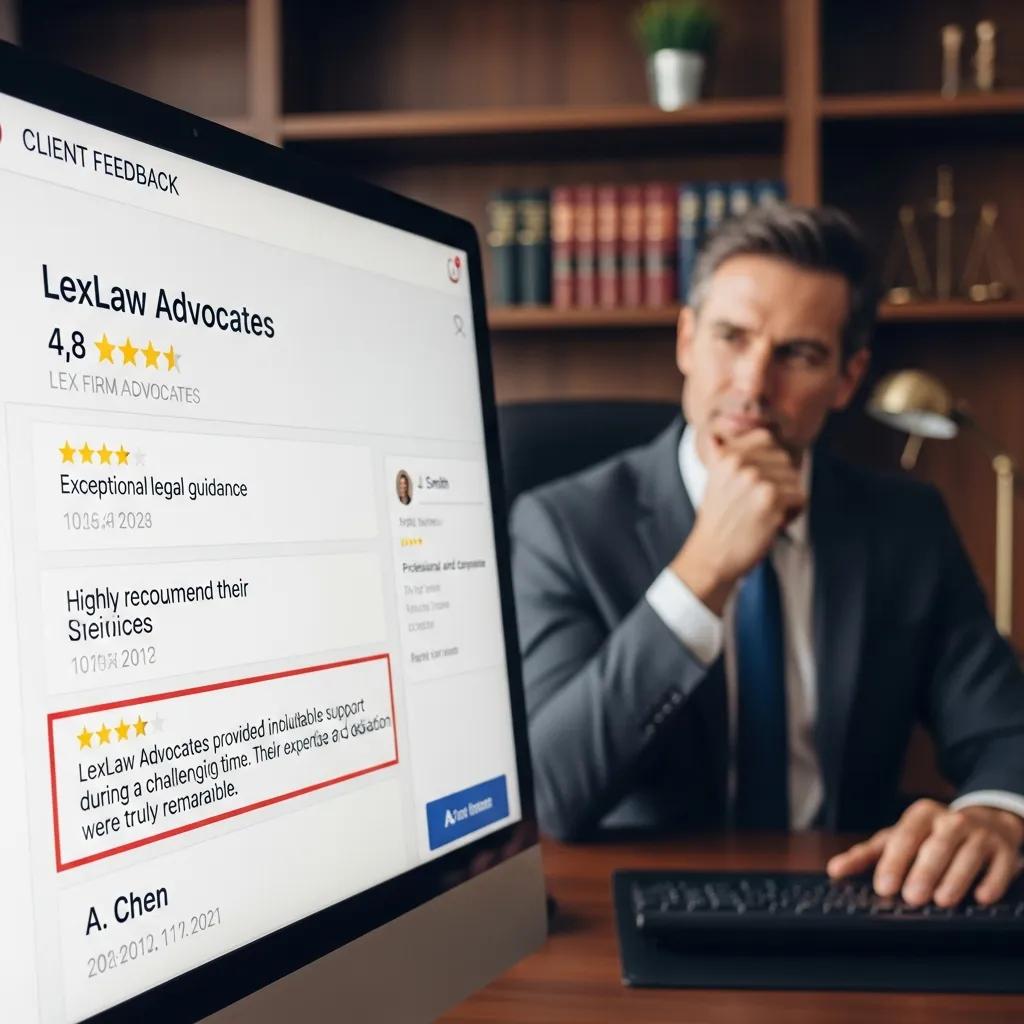
A law firm’s online reputation now sits at the front of its intake pipeline. Prospective clients read reviews before they pick up the phone, and what they find decides whether they pick it up at all. This article covers four things: how reviews affect a firm’s standing, which monitoring tools are worth running, how to answer feedback when it turns negative, and how reputation work fits alongside digital marketing built for law firms.
Key Takeaways
- Online reviews decide what a prospective client believes about your firm before the first call, and review volume also feeds local search rankings.
- Review monitoring software earns its cost through three things: real-time alerts, sentiment analysis, and reporting on review trends.
- A negative review deserves a prompt, professional reply that acknowledges the concern and offers to resolve the matter offline where that is appropriate.
- Asking clients for feedback is still a client communication, so the request process has to be built around the rules governing solicitation from the start.
- Reputation work performs better run alongside SEO, content, and social media than as a separate project.
Legal scholarship has made a similar point about online marketing and firm vigilance for more than a decade.
Law Firm Online Reputation & Marketing Benefits
This article discusses the importance of being vigilant with a firm’s online reputation. This article begins by discussing the benefits of online marketing, such as the low cost, the
Law Firm Marketing in the Age of Social Media: A Toolbox for Attorneys, 2015
How Do Online Reviews Impact Your Law Firm's Reputation?
Reviews shape what a prospective client believes about a firm before any conversation happens. Positive reviews act as trust signals; negative ones give people a reason to keep scrolling. Review volume also feeds into local search rankings, so the two effects compound. That is why the work needs a schedule rather than occasional attention.
Research on attorney regulation draws the same line between reputation and client attraction.
Attorney Reputation Management for Client Attraction
Law firms develop reputations that attract clients to the firm; individual lawyers, both within firms and in solo practice, may and makes the lawyers valuable to other firms in the market for
Online reputation management in attorney regulation, CB Robertson, 2016
One widely cited study found that 84% of people trust online reviews as much as personal recommendations. Firms that let negative feedback sit unanswered risk letting a handful of complaints stand in for the whole practice, and a single unmanaged thread can turn into the first thing a searcher sees.
Firms that would rather not run this in-house can hand it to a specialist. ByteZero Inc. is a digital marketing agency that handles reputation management for law firms, from review monitoring through response workflows.
Why Are Client Feedback and Online Reviews Crucial for Attorneys?
Feedback matters because it arrives before the consultation does. Positive reviews build credibility; negative ones chip away at it. Studies put the share of consumers who will leave a review when asked at 70%, which means the biggest lever most firms have is simply asking.
Reviews also feed local search engine optimization (SEO), which affects where a firm appears in search results. Better visibility puts the practice in front of more of the people already looking for counsel.
What Are the Common Challenges in Managing Legal Online Reviews?
Two problems come up over and over. The first is answering a negative review quickly and professionally when the underlying matter may still be sensitive. Left alone, one complaint can sit at the top of the results for months.
The second is ethics. Attorneys asking for reviews are still bound by the rules governing client interactions and feedback solicitation, so the request process has to be built around those rules rather than retrofitted to them. Handling feedback transparently is part of protecting the reputation, not a separate chore.
Which Attorney Review Monitoring Tools Are Essential in 2026?
Monitoring tools exist so that nobody has to check six review sites by hand every morning. They surface client feedback as it lands, which is what makes a same-day response possible.
The useful ones pull feedback from several sources into a single view. Checking that view on a set schedule is how firms notice a pattern forming instead of discovering it after the fact.
How Do Advanced Review Monitoring Tools Help Law Firms?
These tools centralize alerts and track performance over time. A notification when a review posts turns the response from a scramble into a routine task, and a fast reply blunts the impact of a bad one.
Many also run sentiment analysis, which reads how clients describe the service rather than only counting stars. That is the difference between guessing at a reputation problem and knowing where it starts.
What Features Should You Look for in Legal Reputation Monitoring Software?
Three features matter more than the rest when comparing legal reputation monitoring software:
- Real-Time Alerts: Immediate notifications about new reviews enable prompt responses.
- Sentiment Analysis: Understanding client sentiment helps firms gauge their reputation effectively.
- Comprehensive Reporting: Detailed reports on review trends and performance metrics provide valuable insights.
Together they let a firm work ahead of problems instead of reacting to them.
What Strategies Effectively Repair and Enhance Lawyer Reputation?
Repair work runs on two tracks at once: bringing in fresh feedback from satisfied clients, and dealing properly with the feedback already published.
The first track needs a system, not good intentions. Pick a point in the matter lifecycle where every satisfied client gets asked, and the steady flow that follows keeps any one bad review from carrying more weight than it deserves.
How Can Law Firms Respond to Negative Legal Reviews?
A reply to a negative review should be professional and prompt. Acknowledge the concern, offer a path to resolution where one exists, and keep the tone level. Reviewers sometimes revise a rating after a response that takes them seriously, and everyone else reading is watching how the firm behaves under criticism.
Three habits carry most of the weight:
- Professionalism: Maintain a respectful tone, regardless of the review’s content.
- Timeliness: Respond promptly to show that the firm values client feedback.
- Resolution Offer: If appropriate, offer to resolve the issue offline to prevent further public discussion.
What Legal Reputation Repair Services Boost Client Trust?
Outside reputation repair services earn client trust the way anything else does, through transparent communication and follow-through. The work usually covers review management, client engagement, and the parts of the client experience that generate the reviews in the first place.
Handled well, reputation repair shows clients that the firm takes their experience seriously, and that tends to show up in what people write afterward.
How Can Digital Marketing Protect and Promote Your Law Firm's Online Image?
Reputation management and digital marketing pull in the same direction when they run together. One builds credibility; the other makes sure people see it.
Content creation, social media engagement, and search engine optimization all do double duty. They promote the firm’s services and, at the same time, give positive client experiences somewhere to live and be found.
Research on large firms has looked at how they use social media for impression management.
Law Firm Social Media Impression Management
of how successful law firms use OIM via social media within a Marketing or corporate communication managers in other Consequently, law firms in the second 100 ranking also
Law firms’ organizational impression management strategies on
Twitter, L Kwok, 2017
What Lawyer Reputation Marketing Strategies Drive Client Acquisition?
Three tactics do most of the work here:
- Encouraging Positive Reviews: Actively soliciting feedback from satisfied clients can enhance the firm’s online reputation.
- Local SEO Optimization: Competing for local search results puts the firm in front of people searching nearby.
- Content Marketing: Sharing informative content that addresses client concerns can position the firm as a trusted authority in the legal field.
Run together, they give a firm a presence that holds up to scrutiny.
How Does Integrating Reputation Management with Digital Marketing Improve Results?
Running the two as one program means the firm says the same thing everywhere: on the website, in the search results, and in how it answers a two-star review. That consistency is most of what people mean when they say they trust a practice.
Combining the two also closes the gap where a strong ad campaign sends people to a profile full of unanswered complaints, which is where a lot of legal marketing budget quietly goes to waste.
Frequently Asked Questions
How do online reviews affect a law firm reputation?
Reviews shape what a prospective client believes before the first phone call. Positive ones act as trust signals and support credibility, while unanswered negative ones give people a reason to keep looking elsewhere. Review volume also feeds local search rankings, so the two effects compound over time. That combination is why reviews need scheduled attention rather than an occasional check when someone remembers.
What features should legal reputation monitoring software have?
Three matter most. Real-time alerts tell you a review has posted while a response still feels timely. Sentiment analysis shows how clients describe the service, not just how many stars they left. Comprehensive reporting tracks review trends and performance over time so patterns become visible. Tools that pull feedback from several sources into one view save the most day-to-day effort.
How should a law firm respond to a negative review?
Professionally and promptly. Acknowledge the concern, keep the tone level regardless of what the review says, and offer to resolve the matter offline where that is appropriate. A response written this way sometimes prompts the reviewer to revisit their rating. It is also read by everyone else evaluating the firm, who are watching how it handles criticism in public.
Why is asking clients for reviews complicated for attorneys?
Because the request is still a client communication. Attorneys soliciting feedback remain subject to the rules governing client interactions and solicitation, so the process has to be designed around those rules from the start rather than adjusted afterward. Managing feedback ethically and transparently is part of protecting the reputation, not a compliance step bolted on later. Confirm the requirements in your own jurisdiction.
How does reputation management fit with digital marketing?
They work better as one program. Content creation, social media engagement, and search engine optimization promote the firm and, at the same time, give positive client experiences somewhere to live and be found. Run separately, they create the familiar gap where an ad campaign sends people to a profile full of unanswered complaints. A consistent message across platforms is most of what people mean by trust.
Which reputation marketing tactics help attract new clients?
Three come up repeatedly. Encouraging satisfied clients to leave reviews, through a systematic request rather than an occasional ask. Local SEO, so the firm competes for search results in the area it actually serves. Content marketing that answers the questions prospective clients arrive with, which positions the firm as a trusted authority in its field.