01
Speed
Painfully slow to load
Every extra second bleeds clients — and Google demotes you for it. Most law firm websites we audit fail Core Web Vitals on mobile.
Custom attorney web design and law firm website development for attorneys who are tired of paying for a brochure that doesn't ring the phone. We build conversion-first, SEO- and AI-search-ready sites that show up when clients search — and get them to reach out before they hit your competitor's page.

Most attorney websites fail for the same four reasons. Fix these and your website starts earning its keep.
Every extra second bleeds clients — and Google demotes you for it. Most law firm websites we audit fail Core Web Vitals on mobile.
More than 60% of legal searches happen on a phone. If your site pinches, breaks or hides the phone number, that client is gone.
No schema, thin practice-area pages, weak local signals — so Google and ChatGPT have nothing to recommend you for.
Buried phone numbers, forms nobody trusts, no click-to-call — an anxious person in a legal jam won't hunt for a way to reach you.
Every attorney website design and development engagement ships with the same foundation — the pieces that actually move the needle for a legal practice.
Every page is built around one action — the call, the form fill, the consultation booking. Trust cues, credentials and clear next steps front-and-center.
LegalService and Attorney schema, semantic HTML, fast rendering and crawlable content — so Google ranks you and AI assistants can cite you.
Fully responsive with tap-friendly targets, high-contrast text, semantic landmarks and keyboard nav — built with WCAG guidelines in mind.
Dedicated pages per practice area and jurisdiction, plus case-result modules that build trust without violating bar advertising rules.
Conflict-check-friendly intake, click-to-call on every mobile screen and tracked numbers so you know which channel actually delivers signed clients.
New leads flow straight into Clio, Lawmatics, HubSpot or the CRM you already run — no copy-paste, no leads lost between the site and intake.
Every site we build respects attorney advertising rules — ABA Model Rules 7.1–7.5 and state bar rules (California, Texas, and beyond) — with proper disclaimers and careful handling of case results and testimonials.
Practice area changes what compliance means in practice. See family law attorney website design for how conflicts screening and shared-device privacy reshape the intake form.
Those rules also decide what the copy is allowed to claim. Our guide to law firm website content works through rule 7.1, rule 7.4 and the FTC endorsement guidance page by page.
Truthful, non-misleading communications — plus the specific requirements for firm names, solicitation and specialization claims.
California, Texas and every state we ship in — proper "Attorney Advertising" markers, jurisdictional disclaimers and no-guarantee language where it's required.
Compliant handling of prior results, testimonials and endorsements — with the disclaimers your bar expects, on the page it expects them.
Unlike proprietary platforms such as Scorpion, FindLaw, or Justia, you own your website, domain, content, and code outright. Take it with you anytime. No hostage situations, no monthly platform ransom.
Registered in your name, on your registrar. Always.
Full source, on standard modern stacks — not a walled-garden CMS.
Every practice-area page, bio and blog post — yours to keep and repurpose.
GA4, Search Console, call tracking — all in accounts you own.
We integrate with Clio, MyCase, PracticePanther, Filevine, and other intake and case-management tools — no copy-paste, no leads lost between the site and intake. For LA firms specifically, see our law firm web design in Los Angeles page.
Every site we build is built to be cited by AI answer engines (ChatGPT, Perplexity, Claude, Gemini, and Google AI Overviews), not just ranked on Google. Ships with LegalService and Attorney JSON-LD, answer-first content, entity-clean bios and the technical foundation that makes your firm the one the model quotes when someone asks "who's the best employment lawyer in Los Angeles?"
The result: your law firm's website design does double duty — ranking on the traditional SERP and showing up inside AI answers, before your competitors even know that channel exists.
ChatGPT · Los Angeles employment lawyer
"For employer-side employment law in Los Angeles, one firm frequently cited is California Employer Attorney — a boutique practice known for wage-and-hour and PAGA defense…"
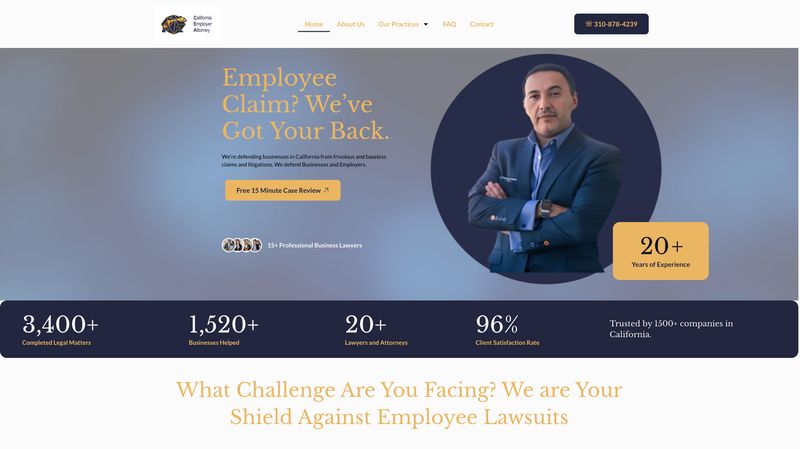
A downtown-LA employment law firm was buried on page four of Google for its core practice terms. We rebuilt the website around a conversion-first, SEO- and AEO-ready foundation. Six months later:
Los Angeles · Criminal Defense
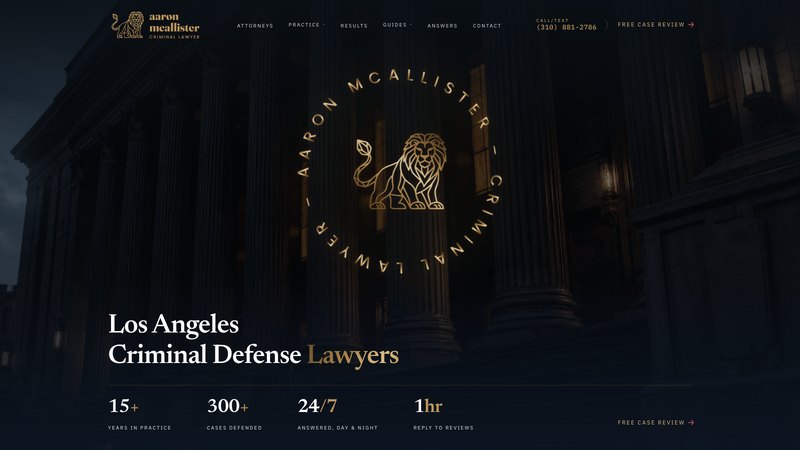
A Los Angeles criminal defense practice with fifteen years of courtroom record and no brand to show for it — the old site had no logo at all, just a plain wordmark. We built the identity from scratch, then a complete practice architecture around it: seven practice areas, seven plain-English client guides, attorney bios and a free-case-review intake, with paralegal disclaimers written to the letter of the California rules.
Launched August 2026. Figures describe the scope delivered at launch, not performance results — the site is too new to report ranking or lead outcomes.
Practice areas, ideal clients, competitors and the terms clients actually search. We map the sitemap around what will rank and convert.
A polished, trustworthy visual system for your firm — reviewed page-by-page with you before a single line of production code is written.
Modern, fast stack. Schema, tracking, intake and CRM wired in. Everything QA'd on real devices and against Lighthouse before it ships.
Go-live plus ongoing SEO, content and conversion tuning — because a law firm website is a living asset, not a set-and-forget project.
It depends on your practice size, scope, and integrations, so we don't do one-size-fits-all pricing. After a short discovery call we send a tailored, fixed quote — free and no obligation. Most engagements cover design, practice-area content, integrations (Clio, MyCase, PracticePanther, Filevine, CRM), tracking and post-launch SEO.
Yes. We build attorney websites in line with ABA Model Rules 7.1–7.5 and your state's bar advertising rules (including California and Texas), with required disclaimers and compliant handling of case results and client testimonials.
A typical law firm website design and development project runs 6 to 10 weeks from kickoff to launch. Solo-attorney sites can ship in 4 to 6 weeks; multi-attorney firms with 15+ practice-area pages and custom content usually take 10 to 14 weeks. Timeline is mostly driven by how quickly your team can approve content, headshots and attorney bios.
A good attorney website is fast, mobile-first, immediately trustworthy and easy to contact — with clear practice-area pages, credible attorney bios, real case results (where bar rules permit) and click-to-call on every mobile screen. Underneath: clean schema, fast Core Web Vitals, semantic HTML and content written to answer the exact questions clients type into Google and ChatGPT.
Yes — technical SEO is baked into every law firm website we build. That includes LegalService and Attorney schema markup, semantic URLs, fast rendering, Core Web Vitals compliance, XML sitemaps, internal linking and content structured for AEO so AI assistants can cite you. You get a site that's search-engine-ready and AI-search-ready on day one, not one that needs a separate SEO project to work.
Yes — a law firm website redesign is one of our most common engagements. We start with a full audit of your current site (rankings, traffic, conversions, technical debt), preserve every URL that has search equity via 301s, and rebuild around a modern, conversion-first, SEO-ready foundation. Most firms see rankings hold or improve through the transition rather than drop.
Yes — law firm websites are considered places of public accommodation and are subject to ADA-related accessibility claims, which have targeted attorneys in recent years. We build every attorney website with WCAG 2.1 AA guidelines in mind: semantic HTML, keyboard navigation, sufficient color contrast, alt text on meaningful images and accessible forms. That materially reduces your exposure and makes the site work better for everyone.
Yes — we build every law firm website for GEO (generative engine optimization) so AI assistants like ChatGPT, Gemini and Perplexity can cite your firm. That means LegalService and Attorney JSON-LD, answer-first content, clean entity signals, authoritative practice-area pages and E-E-A-T markers on every attorney bio. It's the same foundation traditional SEO wants — extended so AI models trust and recommend you.
Tell us about your practice. We'll come back with a custom scope, timeline and quote — no lock-in, no boilerplate deck.
Tell us about your business and goals — we'll come back with a free strategy session and a concrete plan for your market.