

Why a Low CPC Bankrupts Law Firms
In competitive markets like Los Angeles or San Francisco, paid ads for legal terms can exceed $100 per click. Most firms react to that pressure by trying to force their cost per click down. That is the wrong lever.
Key Takeaways
- Cheap clicks are the wrong target. A $20 lead that never answers the phone costs more than a $200 lead that signs a high-value retainer.
- Send outcomes back to Google. Qualified lead $500, appointment set $1,000, signed case $5,000 gives the bidding models a reason to chase retainers instead of form fills.
- Judge the account on cost per signed case, not cost per lead, and take the data from your CRM rather than a website pixel.
- An Orange County personal injury firm spending $50k a month saw lead volume fall 20%, signed cases rise 35% and cost per acquisition fall 40% after connecting Salesforce to Google Ads.
- Broad match is only safe once revenue data is feeding the account. Without it, the same setting spends the budget on irrelevant searches.
Optimizing for cheap clicks is a race to the bottom. A $20 lead that never answers the phone costs a firm more than a $200 lead that signs a high-value retainer. The job of a Google Ads agency is not to generate volume; it is to generate revenue.
That changes what the account is pointed at. Instead of optimizing for leads, you optimize for signed cases by connecting offline intake data from Clio, Filevine or a similar system back to the bidding models. We call it the intake-to-revenue loop.
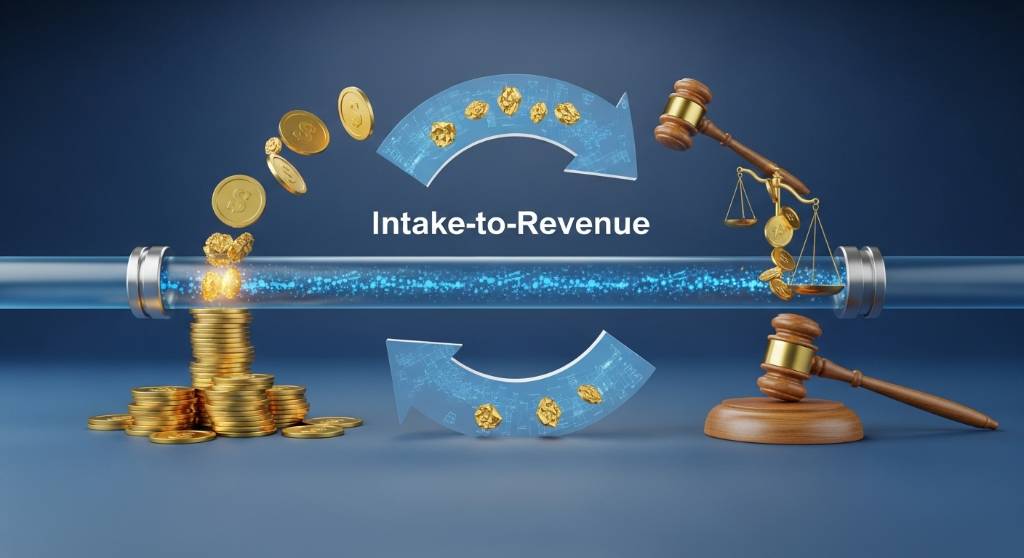
Anatomy of the Feedback Loop
The standard pipeline for most firms is broken. Google Ads sends traffic, a landing page converts a lead, and your intake team chases them. Google never hears what happened next.
The repair is value-based bidding, which means attaching monetary values to specific pipeline stages inside your CRM:
- Qualified lead: $500 signal sent to Google.
- Appointment set: $1,000 signal sent to Google.
- Signed case: $5,000 signal sent to Google.
Feeding the signed-case data back into the system trains the algorithm on the behavior of people who actually hire lawyers, rather than people who simply click ads.
Pixel fires alone make a poor optimization signal. Offline conversion tracking lets you bid on profit rather than participation.
Generalist vs. Specialist
Most generalist agencies run a churn-and-burn model. A specialist Google Ads agency works against the metrics that reach your bottom line. The difference shows up in four places:
| Metric | Generalist agency (standard) | Our specialist approach |
|---|---|---|
| Primary KPI | Cost per lead (CPL) | Cost per signed case (CPSC) |
| Bidding strategy | Maximize clicks | Target ROAS (value-based) |
| Data source | Website pixel (quantity) | CRM integration (quality) |
| Outcome | Intake burnout | Scalable revenue |
Why This Matters for California Firms
California carries some of the highest CPMs in the nation. In markets like San Diego and Sacramento, you cannot afford to pay for bad data. Solid California lawyer website development is the foundation, but data integration is the engine.
Google's shift toward broad match keywords raises the stakes on data quality again. Broad match without revenue data spends the budget on irrelevant searches. Broad match with revenue data spends it on cases.

Cost Per Case, Before and After
When you filter out spam and low-intent clicks, volume drops and profitability rises. This is the typical result of switching to an intake-to-revenue model, where lower is better:
| Approach | Cost per acquisition |
|---|---|
| Standard approach | $4,500 |
| Intake-to-revenue approach | $2,200 |
Based on average results for personal injury campaigns in Los Angeles.
Case Study: The Personal Injury Pivot
A mid-sized personal injury firm in Orange County was spending $50k a month and living with a high cost per case. We audited their intake process and connected their CRM, Salesforce, to Google Ads through the API.
After a 30-day learning phase, three things moved:
- Lead volume dropped by 20% as spam was filtered out.
- Signed cases increased by 35%.
- Cost per acquisition dropped by 40%.
Less noise, more revenue. For firms rebuilding their digital presence, pairing this strategy with high-performance Los Angeles law firm website development gives every click a better chance of converting.

Common Myths in Legal PPC
Myth 1: We need to rank number one for everything.
You only need to reach the users most likely to sign. A top-of-page placement is enough when the targeting is precise, and it costs far less than trying to own every auction.
Myth 2: Google Ads leads are garbage.
The leads are often poor because nobody has told Google what a good lead looks like. Without a feedback loop, the algorithm has nothing to learn from.
Myth 3: Any marketing agency can do this.
Offline conversion tracking takes hands-on experience with legal CRMs and with Google's API. Most generalist agencies do not do that work, and the setup fails quietly when it is done badly.
Your Data Is the Competitive Advantage
Moving from lower CPC to higher return is the difference between buying clicks and buying cases. Most of your competitors are still bidding on vanity metrics, which is what makes the gap worth closing now.
Stop paying for clicks. Start investing in cases. Contact our Google Ads agency to build your intake-to-revenue infrastructure.
Frequently Asked Questions
What is the intake-to-revenue loop in Google Ads?
It is the practice of sending what happens after the form fill back into the ad account. Your CRM records whether a lead was qualified, booked an appointment or signed a retainer, and those outcomes are pushed back to Google as conversion values. Bidding then optimizes toward signed cases rather than toward whichever ad produced the most cheap form fills.
Why is chasing a lower cost per click the wrong goal for a law firm?
Legal clicks in markets like Los Angeles and San Francisco can exceed $100, so a cheaper click feels like progress. It usually is not. A $20 lead that never answers the phone costs more than a $200 lead that signs a high-value retainer. The number worth managing is the cost of a signed case, not the cost of a visit.
What is offline conversion tracking, and why does a law firm need it?
Offline conversion tracking sends outcomes recorded away from the website back to Google Ads. A pixel only knows that somebody submitted a form. Your CRM knows whether that person hired you. Connecting a system such as Clio, Filevine or Salesforce lets the account bid on profit rather than participation, which is also what makes broad match usable instead of wasteful.
What values should we assign to each pipeline stage?
Use values that reflect how close each stage sits to revenue. The structure described here sends $500 for a qualified lead, $1,000 for an appointment set and $5,000 for a signed case. The absolute figures matter less than the ratio between them, because that ratio is what teaches the bidding model which leads are worth paying more to reach.
How long before value-based bidding starts working?
Expect a learning phase before the account settles. In the Orange County personal injury pivot described above, the shift took roughly 30 days after the CRM was connected, and results were measured from that point onward. During that window the algorithm is still collecting outcome data, so reading performance week to week will make a working setup look like a failing one.
What should I look for in a Google Ads agency?
Ask which metric the agency reports against. A generalist reports cost per lead, bids to maximize clicks, and reads results from a website pixel. A specialist reports cost per signed case, bids to a target return on ad spend using values, and pulls data from your CRM. Ask how offline conversions will be connected before agreeing to any management fee.